HS7/159 PART I, 1945.
TRANSCRIPTION.
DUTCH SECTION HISTORY
January 1945 - July 1945.
DUTCH SECTION HISTORY
January 1945 - July 1945.
The first entry of 1945 is a daily report of March 24th till March 25th 1945. This must be just one page out of a log of the Dutch Section of SOE. Where is the rest?
March 24th.
FRIESLAND.
NECKING (Tazelaar) reports that he has 2100 armed men ready in FRIESLAND and that the intelligence service of the Resistance group in his area has now got to work.
OVERIJSSEL.
EDUARD (Hotz) says in answer to a query from SFHQ (See Summary 17th March, para 3) that according to the Commandant of ZWOLLE, the most important buildings of the SD are situated around the VAN NAHUISPLEIN. In addition, important detachments of troops are quartered in the BAGYNESINGEL School.
The Commandant of Zwolle plans to release 150 political prisoners detained in Zwolle and asks SFHQ to support him by arranging a simultaneous attack on the buildings occupied by the SD.
Note: The target is being submitted to the Dutch Government for approval.
UTRECHT.
CUBBING (Ciermans) says that CHARLES will not now be coming out. (See Summary 20st March, para 2). He adds that questions about the ARMENIANS are being considered.
Note: Regarding the ARMENIANS, CUBBING has been told that special action-messages in German could be broadcast on the BBC and was asked if this was suitable. He was also asked if there were quick means of communications between the main body of ARMENIANS and those stationed at WESTERVOORT E-77 and what language they understand.
March 25th.
OVERIJSSEL.
CHARADES (Beekman) says that the SD have a photograph of HUNTING (Hinderink) a brigade instructor under EDUARD (Hotz).
UTRECHT.
CUBBING says that about 400 people were murdered as a reprisal for the attack on the SD Chief RAUTER (See summary 14th March, para 3). The attack was made on the APELDOORN - ARNHEM road, but CUBBING does not say by whom. RAUTER is now in APELDOORN, having been shot in the lung. His driver and one other were killed.
CUBBING states that the FRANS whose operator was arrested (See Summary 19th March, para 5) is not FRANS HALS, but an organiser who was to arrange the SIS dropping on ground LEK Z OO. FRANS himself, another SIS man called ANTON (Pierre d'Aulnis?) and their organisation are still alright.
ROTTERDAM.
SCRAPE (van der Stoep) has acknowledged the receipt of the action messages broadcast to his zone for the sabotage of telecommunications.
SCRAPE (van der Stoep) in answer to a query from SFHQ (See summary 23rd March, para 8) says that the man he wanted to put in charge of the telephone communications is VAN VUUREN.
Again, there are no entries to be found in HS7/159 about dropped agents in 1945. However the first one was dropped on the night of 05/06-01-1945. This was Sjoerdsma, mission SQUEAK.
Sjoerd Sjoerdsma, born 17-04-1921 Schagen, Noord-Holland. Died 21-02-1987 Veghel, Noord-Brabant. Dropped on Stegerenveld, near Ommen, Overijssel. DZ EVERT, H-97. Overrun 00-04-1945. Code name operation SQUEAK I. Code name in the field CHRISTIAAN. WT operator to Brinkgreve, DUDLEY. HS9/1367. Source: Frans Kluiters. See overview Overijssel.
MISSION SCRAPE.
Marius van der Stoep, Born 27-09-1917 Beesd, Noord-Brabant. Died in hospital 09-04-1945 Rotterdam. Dropped on the night of 27/28-02-1945 near Zoetermeer, Zuid-Holland. DZ FLINT H-181. Arrested 05-04-1945, wounded after raid. Code name in the field Magnus van Schelven, or Martin Scheffer. HS9/1510/1. Source: Frans Kluiters.
MISSIONS WHIMPER & SNORT.
Reinder Lieuwes (Rein) Bangma, born 04-01-1921 Amsterdam, died 2005. Dropped in the night of 02/03-03-1945 near Lunteren, Gelderland. DZ GEORGE, H-185. Overrun 19-04-1945. Code name operation WHIMPER. Sabotage instructor and organiser. Operational code name POPEYE. Code name in the field FRED. Training name Bender. HS9/83/7. Source: Frans Kluiters.
Jan Lodewijk van der Weijden, born 17-02-1920 Maasbree. Dropped in the night of 02/03-03-1945 near Lunteren, Gelderland. DZ GEORGE, H-185. Overrun 19-04-1945. Code name operation SNORT. WT operator to Bangma. Signal Plan NESS. Code name in the field AART or PUCK. HS9/1512/2. Source: Frans Kluiters.
.
MISSION CRACKLE.
Brunita Josepha (Jos) Gemeke. Born 03-06-1922 Amsterdam, died … The Hague. Dropped on the night of 10/11-03 1945 near Nieuwkoop, Zuid-Holland. DZ COD, H-179. Overrun 00-05-1945. Operational code name SPHINX. Field name Els van Dalen. HS9/572. Source: Frans Kluiters.
MISSIONS SWISH & PING.
Johannes Josephus Franciscus (Peter) Borghouts, born 05-12-1910 Bergen op Zoom, died 05-02-1966 Rotterdam. Dropped on the night of 17/18-03-1945 near Zoetermeer, Zuid-Holland. DZ EVEREST, H-169. Overrun 00-05-1945. Mission SWISH. To organise resistance by the B.S. Code name in the field Burger. Operational code name PETER-ZUID. Name in the field Jan Willem Tollens. HS9/ 184. Source: Frans Kluiters.
Robert Meindert (Bobby) ten Broek, born 23-02-1924 Tiel, Dropped on the night of 17/18-03-1945 near Zoetermeer, Zuid-Holland. DZ EVEREST, H-169. Overrun 00-05-1945. Mission PING. WT operator to Borghouts. HS9/1451/4. Source: Frans Kluiters.
MISSIONS GRUNT-I & RUMBLE
Anton Marie Jacob (Tom) Gehrels, born 21-02-1925 Haarlemmermeer. Dropped on the night of 23/24-03-1945 on Stegerenveld, near Ommen. DZ EVERT, H-97. Overrun 31-03-1945. Mission GRINT-I. HS9/570/7. Source: Frans Kluiters.
Wouter Pleijsier, born 07-04-1922 Groningen, died 09-02-2005 Opsterland. Dropped on the night of 23/24-03-1945 on Stegerenveld, near Ommen. DZ EVERT, H-97. Overrun 31-03-1945. Mission RUMBLE. WT operator to Gehrels. HS9/1195/2. Source: Frans Kluiters.
MISSION HOOT.
Jacobus Johannes (Johan) Weve, born 14-10-1918 Rotterdam. died 02-04-1992. Dropped on the night of 30/31-03-1945 near Lekkerkerk, Zuid-Holland. DZ JURA, H-104. Overrun 00-05-1945. Mission HOOT. Liaison between resistance Rotterdam and 21st Army Group. HS9/1578. Source: Frans Kluiters.
MISSIONS HISS & RAP.
Johannes Maria Christiaansen, born 15-01-1920 Breda, died 12-03-1988 Rotterdam. Dropped on the night of 03/04-04-1945 on Stegerenveld near Ommen, Overijssel. DZ EVERT, H-97. Mission accomplished 15-04-1945. Mission HISS. Operational code name MARIA. HS9/310/5. Source: Frans Kluiters.
Cornelis den Dekker, born 06-06-1921 Muiden. Dropped on the night of 03/04-04-1945 on Stegerenveld near Ommen, Overijssel. DZ EVERT, H-97. Mission accomplished 15-04-1945. Wireless operator to Christiaansen. Mission RAP. HS9.417. Source: Frans Kluiters.
MISSIONS WHISTLE & JINGLE.
Franciscus (Frans) Dekker, born 30-06-1920 Leiden, died 24-05-1990 Leusden. Dropped on the night of 11/12-04-1945 near Loosdrecht, Utrecht. DZ POPEYE, H-184. Overrun 00-05-1945. Wireless operator to Greidanus or Borghouts. Mission WHISTLE. Name in the field Jan Willem Berger. HS9/413/7. Source: Frans Kluiters.
Johannes (Johan) Greidanus, born 25-08-1916 Sloten, Friesland. Drowned 12-04-1945 Loosdrecht, Utrecht. Dropped on the night of 11/12-04-1945 near Loosdrecht, Utrecht. DZ POPEYE, H-184. Parachute did not open. Mission JINGLE. HS9/621. Source: Frans Kluiters.
MISSIONS HOWL & SCREAM.
Wijtze Bisschop, born 28-04-1918 Amsterdam, died 01-11-2006 The Hague. Dropped on the night of 11/12-04-1945 near Lekkerkerk, Zuid-Holland. DZ JURA, H-104. Sabotage instructor. Mission HOWL. Code name in the field Hendriksen. HS9/157/9. Source: Frans Kluiters.
Hendrik Geijssen, born 24-12-1921 Amsterdam, died 02-10-1994. Dropped on the night of 11/12-04-1945 near Lekkerkerk, Zuid-Holland. DZ JURA, H-104. Sabotage instructor. Mission SCREAM. Training name Gerritzoon. HS9/ 578/2. Source: Frans Kluiters.
MISSION SQUEAK II.
Sjoerd Sjoerdsma, born 17-04-1921 Schagen, Noord-Holland. Died 21-02-1987 Veghel, Noord-Brabant. Dropped on the night of 11-12-04-1945 near Zevenhoven, Utrecht. DZ MATTERHORN, H-177. Overrun 00-05-1945. WT operator to resistance groups in Rotterdam. Mission SQUEAK II. HS9/1367. Source: Frans Kluiters.
MISSIONS GURGLE & RUMBLE II.
Willem Bouma, born 25-01-1920 Drachten. Dropped on the night of 23/24-04-1945 near Spanbroek, Noord-Holland. DZ MANDRILL, H-84. Mission accomplished 00-05-1945. Sabotage instructor. Mission GURGLE. Field name Broekman.
Wouter Pleijsier, born 07-04-1922 Groningen, died 09-02-2005 Opsterland. Dropped on the night of 23/24-04-1945 near Spanbroek, Noord-Holland. DZ MANDRILL, H-84. Overrun 00-05-1945. WT operator to resistance groups in Noord-Holland. Mission RUMBLE II. Operational name RUMBLE. Hs9/1195/2. Source Frans Kluiters.
MISSIONS GRIND, YELP & SPLASH.
Willem Dinger, born 10-09-1916 Amsterdam died 19-05-1989 Amsterdam. Dropped on the night of 23/24-04-1945 near Ter Aar, Zuid-Holland. DZ IKE, H-195. Overrun 00-05-1945. Wireless operator and organiser, to assist Borghouts. Mission GRIND. Training name Damen. Code name in the field W. Smith. HS9/433/8. Source: Frans Kluiters.
Bernardus Petrus Johannes Antonius Nijdam, born 31-03-1920 London. Dropped on the night of 23/24-04-1945 near Ter Aar, Zuid-Holland. DZ IKE, H-195. Severely wounded on landing. Overrun 00-05-1945. To assist Borghouts. Mission YELP. HS9/1103. Source Frans Kluiters.
Floris Edmond Marie van der Putt, born 25-03-1921 Eindhoven. Dropped on the night of 23/24-04-1945 near Ter Aar, Zuid-Holland. DZ IKE, H-195. Overrun 00-05-1945. WT operator and organiser, to assist Borghouts. Mission SPLASH. Field name Floris Palstra. HS9/1509/1/ Source: Frans Kluiters.
MISSIONS GRUNT II & FIZZ.
Anton Marie Jacob (Tom) Gehrels, born 21-02-1925 Haarlemmermeer. Dropped on the night of 23/24-04-1945 near Nieuwkoop, Zuid-Holland. DZ COD, H-179. Overrun 00-05-1945. Sabotage instructor. Mission GRUNT II. HS9/570/7. Source: Frans Kluiters.
Ferdinand Theodorus Stuvel, born 06-11-1919 The Hague. Dropped on the night of 23/24-04-1945 near Nieuwkoop, Zuid-Holland. DZ COD, H-179. Overrun 00-05-1945. WT operator to Gehrels, set damaged beyond repair during landing. Mission FIZZ. Operational name ERNST. Field name Dirk Maas. HS9/1426/4. Source: Frans Kluiters.
March 24th.
FRIESLAND.
NECKING (Tazelaar) reports that he has 2100 armed men ready in FRIESLAND and that the intelligence service of the Resistance group in his area has now got to work.
OVERIJSSEL.
EDUARD (Hotz) says in answer to a query from SFHQ (See Summary 17th March, para 3) that according to the Commandant of ZWOLLE, the most important buildings of the SD are situated around the VAN NAHUISPLEIN. In addition, important detachments of troops are quartered in the BAGYNESINGEL School.
The Commandant of Zwolle plans to release 150 political prisoners detained in Zwolle and asks SFHQ to support him by arranging a simultaneous attack on the buildings occupied by the SD.
Note: The target is being submitted to the Dutch Government for approval.
UTRECHT.
CUBBING (Ciermans) says that CHARLES will not now be coming out. (See Summary 20st March, para 2). He adds that questions about the ARMENIANS are being considered.
Note: Regarding the ARMENIANS, CUBBING has been told that special action-messages in German could be broadcast on the BBC and was asked if this was suitable. He was also asked if there were quick means of communications between the main body of ARMENIANS and those stationed at WESTERVOORT E-77 and what language they understand.
March 25th.
OVERIJSSEL.
CHARADES (Beekman) says that the SD have a photograph of HUNTING (Hinderink) a brigade instructor under EDUARD (Hotz).
UTRECHT.
CUBBING says that about 400 people were murdered as a reprisal for the attack on the SD Chief RAUTER (See summary 14th March, para 3). The attack was made on the APELDOORN - ARNHEM road, but CUBBING does not say by whom. RAUTER is now in APELDOORN, having been shot in the lung. His driver and one other were killed.
CUBBING states that the FRANS whose operator was arrested (See Summary 19th March, para 5) is not FRANS HALS, but an organiser who was to arrange the SIS dropping on ground LEK Z OO. FRANS himself, another SIS man called ANTON (Pierre d'Aulnis?) and their organisation are still alright.
ROTTERDAM.
SCRAPE (van der Stoep) has acknowledged the receipt of the action messages broadcast to his zone for the sabotage of telecommunications.
SCRAPE (van der Stoep) in answer to a query from SFHQ (See summary 23rd March, para 8) says that the man he wanted to put in charge of the telephone communications is VAN VUUREN.
Again, there are no entries to be found in HS7/159 about dropped agents in 1945. However the first one was dropped on the night of 05/06-01-1945. This was Sjoerdsma, mission SQUEAK.
Sjoerd Sjoerdsma, born 17-04-1921 Schagen, Noord-Holland. Died 21-02-1987 Veghel, Noord-Brabant. Dropped on Stegerenveld, near Ommen, Overijssel. DZ EVERT, H-97. Overrun 00-04-1945. Code name operation SQUEAK I. Code name in the field CHRISTIAAN. WT operator to Brinkgreve, DUDLEY. HS9/1367. Source: Frans Kluiters. See overview Overijssel.
MISSION SCRAPE.
Marius van der Stoep, Born 27-09-1917 Beesd, Noord-Brabant. Died in hospital 09-04-1945 Rotterdam. Dropped on the night of 27/28-02-1945 near Zoetermeer, Zuid-Holland. DZ FLINT H-181. Arrested 05-04-1945, wounded after raid. Code name in the field Magnus van Schelven, or Martin Scheffer. HS9/1510/1. Source: Frans Kluiters.
MISSIONS WHIMPER & SNORT.
Reinder Lieuwes (Rein) Bangma, born 04-01-1921 Amsterdam, died 2005. Dropped in the night of 02/03-03-1945 near Lunteren, Gelderland. DZ GEORGE, H-185. Overrun 19-04-1945. Code name operation WHIMPER. Sabotage instructor and organiser. Operational code name POPEYE. Code name in the field FRED. Training name Bender. HS9/83/7. Source: Frans Kluiters.
Jan Lodewijk van der Weijden, born 17-02-1920 Maasbree. Dropped in the night of 02/03-03-1945 near Lunteren, Gelderland. DZ GEORGE, H-185. Overrun 19-04-1945. Code name operation SNORT. WT operator to Bangma. Signal Plan NESS. Code name in the field AART or PUCK. HS9/1512/2. Source: Frans Kluiters.
.
MISSION CRACKLE.
Brunita Josepha (Jos) Gemeke. Born 03-06-1922 Amsterdam, died … The Hague. Dropped on the night of 10/11-03 1945 near Nieuwkoop, Zuid-Holland. DZ COD, H-179. Overrun 00-05-1945. Operational code name SPHINX. Field name Els van Dalen. HS9/572. Source: Frans Kluiters.
MISSIONS SWISH & PING.
Johannes Josephus Franciscus (Peter) Borghouts, born 05-12-1910 Bergen op Zoom, died 05-02-1966 Rotterdam. Dropped on the night of 17/18-03-1945 near Zoetermeer, Zuid-Holland. DZ EVEREST, H-169. Overrun 00-05-1945. Mission SWISH. To organise resistance by the B.S. Code name in the field Burger. Operational code name PETER-ZUID. Name in the field Jan Willem Tollens. HS9/ 184. Source: Frans Kluiters.
Robert Meindert (Bobby) ten Broek, born 23-02-1924 Tiel, Dropped on the night of 17/18-03-1945 near Zoetermeer, Zuid-Holland. DZ EVEREST, H-169. Overrun 00-05-1945. Mission PING. WT operator to Borghouts. HS9/1451/4. Source: Frans Kluiters.
MISSIONS GRUNT-I & RUMBLE
Anton Marie Jacob (Tom) Gehrels, born 21-02-1925 Haarlemmermeer. Dropped on the night of 23/24-03-1945 on Stegerenveld, near Ommen. DZ EVERT, H-97. Overrun 31-03-1945. Mission GRINT-I. HS9/570/7. Source: Frans Kluiters.
Wouter Pleijsier, born 07-04-1922 Groningen, died 09-02-2005 Opsterland. Dropped on the night of 23/24-03-1945 on Stegerenveld, near Ommen. DZ EVERT, H-97. Overrun 31-03-1945. Mission RUMBLE. WT operator to Gehrels. HS9/1195/2. Source: Frans Kluiters.
MISSION HOOT.
Jacobus Johannes (Johan) Weve, born 14-10-1918 Rotterdam. died 02-04-1992. Dropped on the night of 30/31-03-1945 near Lekkerkerk, Zuid-Holland. DZ JURA, H-104. Overrun 00-05-1945. Mission HOOT. Liaison between resistance Rotterdam and 21st Army Group. HS9/1578. Source: Frans Kluiters.
MISSIONS HISS & RAP.
Johannes Maria Christiaansen, born 15-01-1920 Breda, died 12-03-1988 Rotterdam. Dropped on the night of 03/04-04-1945 on Stegerenveld near Ommen, Overijssel. DZ EVERT, H-97. Mission accomplished 15-04-1945. Mission HISS. Operational code name MARIA. HS9/310/5. Source: Frans Kluiters.
Cornelis den Dekker, born 06-06-1921 Muiden. Dropped on the night of 03/04-04-1945 on Stegerenveld near Ommen, Overijssel. DZ EVERT, H-97. Mission accomplished 15-04-1945. Wireless operator to Christiaansen. Mission RAP. HS9.417. Source: Frans Kluiters.
MISSIONS WHISTLE & JINGLE.
Franciscus (Frans) Dekker, born 30-06-1920 Leiden, died 24-05-1990 Leusden. Dropped on the night of 11/12-04-1945 near Loosdrecht, Utrecht. DZ POPEYE, H-184. Overrun 00-05-1945. Wireless operator to Greidanus or Borghouts. Mission WHISTLE. Name in the field Jan Willem Berger. HS9/413/7. Source: Frans Kluiters.
Johannes (Johan) Greidanus, born 25-08-1916 Sloten, Friesland. Drowned 12-04-1945 Loosdrecht, Utrecht. Dropped on the night of 11/12-04-1945 near Loosdrecht, Utrecht. DZ POPEYE, H-184. Parachute did not open. Mission JINGLE. HS9/621. Source: Frans Kluiters.
MISSIONS HOWL & SCREAM.
Wijtze Bisschop, born 28-04-1918 Amsterdam, died 01-11-2006 The Hague. Dropped on the night of 11/12-04-1945 near Lekkerkerk, Zuid-Holland. DZ JURA, H-104. Sabotage instructor. Mission HOWL. Code name in the field Hendriksen. HS9/157/9. Source: Frans Kluiters.
Hendrik Geijssen, born 24-12-1921 Amsterdam, died 02-10-1994. Dropped on the night of 11/12-04-1945 near Lekkerkerk, Zuid-Holland. DZ JURA, H-104. Sabotage instructor. Mission SCREAM. Training name Gerritzoon. HS9/ 578/2. Source: Frans Kluiters.
MISSION SQUEAK II.
Sjoerd Sjoerdsma, born 17-04-1921 Schagen, Noord-Holland. Died 21-02-1987 Veghel, Noord-Brabant. Dropped on the night of 11-12-04-1945 near Zevenhoven, Utrecht. DZ MATTERHORN, H-177. Overrun 00-05-1945. WT operator to resistance groups in Rotterdam. Mission SQUEAK II. HS9/1367. Source: Frans Kluiters.
MISSIONS GURGLE & RUMBLE II.
Willem Bouma, born 25-01-1920 Drachten. Dropped on the night of 23/24-04-1945 near Spanbroek, Noord-Holland. DZ MANDRILL, H-84. Mission accomplished 00-05-1945. Sabotage instructor. Mission GURGLE. Field name Broekman.
Wouter Pleijsier, born 07-04-1922 Groningen, died 09-02-2005 Opsterland. Dropped on the night of 23/24-04-1945 near Spanbroek, Noord-Holland. DZ MANDRILL, H-84. Overrun 00-05-1945. WT operator to resistance groups in Noord-Holland. Mission RUMBLE II. Operational name RUMBLE. Hs9/1195/2. Source Frans Kluiters.
MISSIONS GRIND, YELP & SPLASH.
Willem Dinger, born 10-09-1916 Amsterdam died 19-05-1989 Amsterdam. Dropped on the night of 23/24-04-1945 near Ter Aar, Zuid-Holland. DZ IKE, H-195. Overrun 00-05-1945. Wireless operator and organiser, to assist Borghouts. Mission GRIND. Training name Damen. Code name in the field W. Smith. HS9/433/8. Source: Frans Kluiters.
Bernardus Petrus Johannes Antonius Nijdam, born 31-03-1920 London. Dropped on the night of 23/24-04-1945 near Ter Aar, Zuid-Holland. DZ IKE, H-195. Severely wounded on landing. Overrun 00-05-1945. To assist Borghouts. Mission YELP. HS9/1103. Source Frans Kluiters.
Floris Edmond Marie van der Putt, born 25-03-1921 Eindhoven. Dropped on the night of 23/24-04-1945 near Ter Aar, Zuid-Holland. DZ IKE, H-195. Overrun 00-05-1945. WT operator and organiser, to assist Borghouts. Mission SPLASH. Field name Floris Palstra. HS9/1509/1/ Source: Frans Kluiters.
MISSIONS GRUNT II & FIZZ.
Anton Marie Jacob (Tom) Gehrels, born 21-02-1925 Haarlemmermeer. Dropped on the night of 23/24-04-1945 near Nieuwkoop, Zuid-Holland. DZ COD, H-179. Overrun 00-05-1945. Sabotage instructor. Mission GRUNT II. HS9/570/7. Source: Frans Kluiters.
Ferdinand Theodorus Stuvel, born 06-11-1919 The Hague. Dropped on the night of 23/24-04-1945 near Nieuwkoop, Zuid-Holland. DZ COD, H-179. Overrun 00-05-1945. WT operator to Gehrels, set damaged beyond repair during landing. Mission FIZZ. Operational name ERNST. Field name Dirk Maas. HS9/1426/4. Source: Frans Kluiters.
MAY - JUNE - JULY - 1945.
GENERAL SITUATION.
On Thursday, May 3rd, the situation was that General REICHELT had informed General FOULKES that the German troops would surrender at once if they got an assurance that they would not be sent to RUSSIA as prisoners of War. General FOULKES passed this matter on to the 21st Army Group, but before the answer to this question arrived, General MONTGOMERY received, and signed, the official capitulation of all German forces in Northern Europe, excluding NORWAY, but including HOLLAND. This, naturally ended all the direct arrangements between General FOULKES and General REICHELT of surrender of the German forces in Holland as the conditions laid down by General MONTGOMERY were now valid for these forces also.
One of these conditions was that the German forces should be concentrated in certain areas to be designed by General FOULKES and to proceed to these areas after Allied troops had occupied Western Holland and specially that they were allowed to retain their arms until this had taken place. This immediately put a stop to the possibilities of the German forces surrendering to the Forces of the Interior (N.B.S.), whose task now became even more limited.
On Saturday, May 5th, at 10:00 Hours, a meeting to which PRINCE BERNHARD was invited, took place between General FOULKES and General REICHELT to discuss the capitulation and the necessary measures to be taken.
This was followed by a meeting in the afternoon of May 5th with General BLASKOWITZ. General BLASKOWITZ was told that the Forces of the Interior had to be recognized and they would as from now, appear armed in public. He was further informed that the 49th Division would march into Western Holland on Sunday May 6th and that he would be held responsible for any incidents or any disorder which might interfere with the smooth settlement of everything. General BLASKOWITZ pointed out that German Communications were extremely bad and that in order to give the necessary orders to all his troops he asked General FOULKES whether he could possible consider postponing the entry of the 49th Division. by 24 hours, as otherwise it would be practically impossible for him to prevent incidents and he thought that it was rather unfair. General FOULKES agreed, that, if German communications were so bad, he would postpone the entry of the 49th Division by 24 hours. General BLASKOWITZ then pointed out that if the INTERIOR FORCES appeared armed in the streets while his troops had not been informed of the true state of affairs and in view of the very high feeling of the Dutch population against the Germans, this would certainly lead to incidents, as his troops would have to protect themselves by making use of their arms. He again inquired whether General FOULKES and PRINCE BERNHARD would consider ordering the Resistance Groups not to carry arms until such time as First Corps had taken full charge and German troops were disarmed as, if he was to be held responsible for any incidents, this would be an almost impossible task for him.
General FOULKES and PRINCE BERNHARD agreed that this situation might lead to great disturbance, which had to be avoided at costs and PRINCE BERNHARD agreed in order all Resistance Forcesnot to carry arms in public until further notice.
On Sunday, May 6th, PRINCE BERNHARD telephoned to Major General KOOT and asked him about the effect of this order. PRINCE BERNHARD was informed that the troops of the Resistance Forces would be bitterly disappointed no t to be able to be of any service and the fact that they would not be allowed to carry arms would be a blow to their morale. It was decided to issue an order of the day, pointing out the necessity to obey this order strictly. In effect this order was issued on Monday, May 7th.
On Sunday afternoon, May 6th, General FOULKES had another conference with General BLASKOWITZ, to which PRINCE BERNHARD was invited, to sign the official capitulation. Several small incidents had occurred which were discussed between the interested parties and it was agreed that they should be settled on the spot between General REICHELT and Major General KOOT. It was also agreed that it was almost impossible to decide who had started these incidents, and the least said about it the better. (Casualties were small and about even on both sides).
The Corps Commander, General FOULKES, then promised PRINCE BERNHARD to allow the Interior Forces to carry arms al the earliest possible moment. On Monday morning, May 7th, General KOOT informed PRINCE BERNHARD by telephone that in several places in Western Holland the German Commanders had asked Resistance troops to carry arms and help them to ensure law and order. General KOOT was informed that the decision already arrived and should not be interfered with as the German Commanders still carried full responsibility but that if they took it upon themselves to ask Resistance troops to go out armed, it would be up to them to make sure nothing happened. This arrangement was put into practice in several places during the following week and caused no trouble anywhere.
On the same day, however, Brigadier General SPALDING, 1st Corps, drove through AMSTERDAM under German safe custody, with one German car in front and two German cars behind and was fired upon. Several people in his car were wounded and the bullets found were from British Sten Guns.
General FOULKES informed PRINCE BERNHARD of this in the evening of Monday, May 7th and said that he did not want to lose the life of one single more Canadian soldier and if Resistance troops were undisciplined, he would have to proclaim martial law; in the meantime he would issue an order to shoot on sight at any civilian carrying arms.
PRINCE BERNHARD pointed out to the General that a great many German Gestapo personnel and even German Army personnel were armed with British Sten Guns which they carried even in public and that moreover certain Extremist groups (Landwacht?) had been armed with British material by the Germans after September 1944. PRINCE BERNHARD also pointed out to general FOULKES that he had foreseen this and that, to avoid such instances by either German provocateurs of Extremist groups he had, several months ago, issued orders that all Resistance troops should be concentrated in companies, immediately after Liberation and to be provided, if possible with uniforms; if this was not possible, they should provided with armbands which could not be imitated easily. In view of the situation that had arisen, however, he had not been able to carry out these ideas, nor had the Resistance commanders been able to do so. He had intended to make the carrying of arms illegal by anyone except those in uniform or wearing the authorised armband
General FOULKES finally agreed that it was most unlikely that Resistance personnel had been the cause of the above mentioned incident, but in order to eliminate those elements which might create trouble, PRINCE BERNHARD agreed that he would telephone immediately to AMSTERDAM to issue orders that in the three towns of AMSTERDAM, THE HAGUE and ROTTERDAM, as from Tuesday, May 8th, 07:00 hours, all Resistance troops should carry no arms, as these seen on the streets carrying arms would not be authorised Resistance personnel. At the same time General FOULKES said, that in order to ensure that these people would be able to carry arms again as soon as possible, he would provide uniform arm bands from Army sources, to be issued to personnel assisting 1st Corps.
On Tuesday, May 8th, PRINCE BERNHARD again telephoned to General KOOT at AMSTERDAM. The necessary orders had been passed out during the night, but General KOOT pointed out that the local Allied commander had asked Resistance personnel to carry arms in THE HAGUE in order to help him. PRINCE BERNHARD agreed that this private arrangement should not be interfered with, as local commanders must be allowed to use their own judgement.
On the evening of Tuesday, May 8th, PRINCE BERNHARD was informed by 1st Corps that General FOULKES was going to issue enough arm bands to arm all Resistance personnel in Western Holland that would be needed by 1st Corps and that he would, at the same time, issue an order that no other type of arm bands would authorise the wearer to carry arms. PRINCE BERNHARD agreed that this was a very logical solution and hoped that it would be carried out satisfactorily everywhere.
Wednesday May 9th, PRINCE BERNHARD passed through AMERSFOORT, UTRECHT, ROTTERDAM, THE HAGUE and AMSTERDAM. he noticed that the above mentioned order had not yet been carried out anywhere, and that armed Resistance troops were on duty at several places, sometimes together with German armed personnel on guard duty. They wore different sorts of arm bands, but not a single one provided by 1st Corps. However, on first sight, everybody seemed to be content - at least those he saw. he also saw a great number of Resistance personnel not carrying arms.
During the evening of May 9th, PRINCE BERNHARD had a meeting in a house near AMSTERDAM with General KOOT and his junior commanders, where he discussed the whole situation and its possibilities. It was agreed there was very little they could do at that moment and that, as it was a very bitter disappointment for the Resistance Troops to be standing idle after waiting four years for this moment, the best that could be done was to give them something to do as soon as it could possible be arranged.
On Thursday May 10th, PRINCE BERNHARD telephoned to General FOULKES to inform him of several authorisations that SHAEF had given regarding the employment of German prisoners and several requests from the Dutch Government regarding material used by the Germans and which was previously Dutch property. General FOULKES informed PRINCE BERNHARD that everything was going very well, that he had a great number of arm bands now available which would be issued and that everything should continue to be quite satisfactory.
On Friday May 11th, several reports came in from PRINCE BERNHARD's liaison officers from Western Holland. According to these reports there were cases of the public getting out of hand because the interior forces could not ensure law and order because, not having armbands, they could not be armed. There were cases of individuals who should have been arrested, but were still free and this was also causing unrest amongst the civil population. In some places arrests were carried out by the civilians themselves. There were other serious instances but too numerous to relate.
PRINCE BERNHARD therefore decided to send major MEYNEN and Major BOEKKOOI, both of his staff, to 1st. Corps to make sure that the issue of arm bands, which authorised the carrying of arms would be taken in hand at once, as more delay would cause greater confusion and have a lasting influence on Dutch internal affairs.
The two officers were informed by Brigadier KITCHING, Chief of Staff 1st. Corps, that everything was well in hand and that the Corps Commander would personally issue a proclamation to the Interior Forces to the effect that he would issue the necessary arm bands for all personnel requiring arms to carry out their duties.
In the afternoon Lt. Colonel DE ROME, O.C. 2nd SF Detachment, who had been attached to 1st. Corps came to see PRINCE BERNHARD and Major FROWEIN and the different problems that had arisen out of the confusion of carrying arms and armbands was discussed. Lt.Col. DE ROME promised to discuss the matter with 1st. Corps the same evening and where he hoped that their wishes would be met with full sympathy and dealt with.
Lt. Col. DE ROME was especially asked to pint out to the Corps Commander that the Interior Forces had already shown discipline by carrying out strictly - orders, which under the circumstances, made discipline most difficult indeed.
On Saturday, May12th, PRINCE BERNHARD flew to SHAEF to discuss with Lt. General BEDELL SMITH the raising of battalions from Resistance forces and to hear their views on the employment of the resistance during these days and in the near future. He was informed that the Interior Forces of THE NETHERLANDS were still directly under General EISENHOWER's command and that if PRINCE BERNHARD as their commander, wanted any additional equipment for them, General FOULKES, who would then hold all German equipment, was naturally authorised to issue as much as considered necessary for the duties of the Interior Forces, either for the Allies or for the Dutch themselves.
As things were running quite smoothly now, General FOULKES agreed that arm bands and arms should be handed out for purely Dutch requirements, i.e. for arrests, maintenance of law and order and so on.
On Sunday May 17th, General FOULKES visited PRINCE BERNHARD's HQ together with Lt.Col. DE ROME, for a final conference and informed PRINCE BERNHARD that he had more than 20.000 arm bands i.e. the number needed for Canadian and Netherlands requirements. Lt.Col. DE ROME was made responsible for handing out these arm bands and it was agreed that the Regional Commanders should be held responsible for distributing them to those people that they could vouch for.
Henceforth the procedure to receive arm bands for each region was as follows: The Regional Commander would inform the PRINCE's Liaison Officer or the 2nd Special Forces Liaison Officer as to the numbers required for Army duties and numbers for civilian duties. These in turn orders the necessary number through Lt.Col. DE ROME at 1st. Corps.
The next few days the country was toured to make sure that this arrangement was being carried out satisfactorily.
Summing up the whole situation it can be definitely stated that under the circumstances the discipline of the INTERIOR FORCES was extraordinarily good and although provocations from the German side were not lacking, no serious incidents occurred again.
Paul Reichelt (29 March 1898 - 15 July 1981) was a highly decorated Generalleutnant in the Wehrmacht during World War II and in the Bundeswehr. He was a recipient of the Knight's Cross of the Iron Cross of Nazi Germany.
Awards and decorations
German Cross in Gold on 25 April 1942 as Oberstleutnant im Generalstab in General-Kommando IX. Armeekorps
Knight's Cross of the Iron Cross on 8 October 1944 as Generalmajor and Chief of the general staff of Armee-Abteilung Narwa
Source: Wikipedia.
GENERAL SITUATION.
On Thursday, May 3rd, the situation was that General REICHELT had informed General FOULKES that the German troops would surrender at once if they got an assurance that they would not be sent to RUSSIA as prisoners of War. General FOULKES passed this matter on to the 21st Army Group, but before the answer to this question arrived, General MONTGOMERY received, and signed, the official capitulation of all German forces in Northern Europe, excluding NORWAY, but including HOLLAND. This, naturally ended all the direct arrangements between General FOULKES and General REICHELT of surrender of the German forces in Holland as the conditions laid down by General MONTGOMERY were now valid for these forces also.
One of these conditions was that the German forces should be concentrated in certain areas to be designed by General FOULKES and to proceed to these areas after Allied troops had occupied Western Holland and specially that they were allowed to retain their arms until this had taken place. This immediately put a stop to the possibilities of the German forces surrendering to the Forces of the Interior (N.B.S.), whose task now became even more limited.
On Saturday, May 5th, at 10:00 Hours, a meeting to which PRINCE BERNHARD was invited, took place between General FOULKES and General REICHELT to discuss the capitulation and the necessary measures to be taken.
This was followed by a meeting in the afternoon of May 5th with General BLASKOWITZ. General BLASKOWITZ was told that the Forces of the Interior had to be recognized and they would as from now, appear armed in public. He was further informed that the 49th Division would march into Western Holland on Sunday May 6th and that he would be held responsible for any incidents or any disorder which might interfere with the smooth settlement of everything. General BLASKOWITZ pointed out that German Communications were extremely bad and that in order to give the necessary orders to all his troops he asked General FOULKES whether he could possible consider postponing the entry of the 49th Division. by 24 hours, as otherwise it would be practically impossible for him to prevent incidents and he thought that it was rather unfair. General FOULKES agreed, that, if German communications were so bad, he would postpone the entry of the 49th Division by 24 hours. General BLASKOWITZ then pointed out that if the INTERIOR FORCES appeared armed in the streets while his troops had not been informed of the true state of affairs and in view of the very high feeling of the Dutch population against the Germans, this would certainly lead to incidents, as his troops would have to protect themselves by making use of their arms. He again inquired whether General FOULKES and PRINCE BERNHARD would consider ordering the Resistance Groups not to carry arms until such time as First Corps had taken full charge and German troops were disarmed as, if he was to be held responsible for any incidents, this would be an almost impossible task for him.
General FOULKES and PRINCE BERNHARD agreed that this situation might lead to great disturbance, which had to be avoided at costs and PRINCE BERNHARD agreed in order all Resistance Forcesnot to carry arms in public until further notice.
On Sunday, May 6th, PRINCE BERNHARD telephoned to Major General KOOT and asked him about the effect of this order. PRINCE BERNHARD was informed that the troops of the Resistance Forces would be bitterly disappointed no t to be able to be of any service and the fact that they would not be allowed to carry arms would be a blow to their morale. It was decided to issue an order of the day, pointing out the necessity to obey this order strictly. In effect this order was issued on Monday, May 7th.
On Sunday afternoon, May 6th, General FOULKES had another conference with General BLASKOWITZ, to which PRINCE BERNHARD was invited, to sign the official capitulation. Several small incidents had occurred which were discussed between the interested parties and it was agreed that they should be settled on the spot between General REICHELT and Major General KOOT. It was also agreed that it was almost impossible to decide who had started these incidents, and the least said about it the better. (Casualties were small and about even on both sides).
The Corps Commander, General FOULKES, then promised PRINCE BERNHARD to allow the Interior Forces to carry arms al the earliest possible moment. On Monday morning, May 7th, General KOOT informed PRINCE BERNHARD by telephone that in several places in Western Holland the German Commanders had asked Resistance troops to carry arms and help them to ensure law and order. General KOOT was informed that the decision already arrived and should not be interfered with as the German Commanders still carried full responsibility but that if they took it upon themselves to ask Resistance troops to go out armed, it would be up to them to make sure nothing happened. This arrangement was put into practice in several places during the following week and caused no trouble anywhere.
On the same day, however, Brigadier General SPALDING, 1st Corps, drove through AMSTERDAM under German safe custody, with one German car in front and two German cars behind and was fired upon. Several people in his car were wounded and the bullets found were from British Sten Guns.
General FOULKES informed PRINCE BERNHARD of this in the evening of Monday, May 7th and said that he did not want to lose the life of one single more Canadian soldier and if Resistance troops were undisciplined, he would have to proclaim martial law; in the meantime he would issue an order to shoot on sight at any civilian carrying arms.
PRINCE BERNHARD pointed out to the General that a great many German Gestapo personnel and even German Army personnel were armed with British Sten Guns which they carried even in public and that moreover certain Extremist groups (Landwacht?) had been armed with British material by the Germans after September 1944. PRINCE BERNHARD also pointed out to general FOULKES that he had foreseen this and that, to avoid such instances by either German provocateurs of Extremist groups he had, several months ago, issued orders that all Resistance troops should be concentrated in companies, immediately after Liberation and to be provided, if possible with uniforms; if this was not possible, they should provided with armbands which could not be imitated easily. In view of the situation that had arisen, however, he had not been able to carry out these ideas, nor had the Resistance commanders been able to do so. He had intended to make the carrying of arms illegal by anyone except those in uniform or wearing the authorised armband
General FOULKES finally agreed that it was most unlikely that Resistance personnel had been the cause of the above mentioned incident, but in order to eliminate those elements which might create trouble, PRINCE BERNHARD agreed that he would telephone immediately to AMSTERDAM to issue orders that in the three towns of AMSTERDAM, THE HAGUE and ROTTERDAM, as from Tuesday, May 8th, 07:00 hours, all Resistance troops should carry no arms, as these seen on the streets carrying arms would not be authorised Resistance personnel. At the same time General FOULKES said, that in order to ensure that these people would be able to carry arms again as soon as possible, he would provide uniform arm bands from Army sources, to be issued to personnel assisting 1st Corps.
On Tuesday, May 8th, PRINCE BERNHARD again telephoned to General KOOT at AMSTERDAM. The necessary orders had been passed out during the night, but General KOOT pointed out that the local Allied commander had asked Resistance personnel to carry arms in THE HAGUE in order to help him. PRINCE BERNHARD agreed that this private arrangement should not be interfered with, as local commanders must be allowed to use their own judgement.
On the evening of Tuesday, May 8th, PRINCE BERNHARD was informed by 1st Corps that General FOULKES was going to issue enough arm bands to arm all Resistance personnel in Western Holland that would be needed by 1st Corps and that he would, at the same time, issue an order that no other type of arm bands would authorise the wearer to carry arms. PRINCE BERNHARD agreed that this was a very logical solution and hoped that it would be carried out satisfactorily everywhere.
Wednesday May 9th, PRINCE BERNHARD passed through AMERSFOORT, UTRECHT, ROTTERDAM, THE HAGUE and AMSTERDAM. he noticed that the above mentioned order had not yet been carried out anywhere, and that armed Resistance troops were on duty at several places, sometimes together with German armed personnel on guard duty. They wore different sorts of arm bands, but not a single one provided by 1st Corps. However, on first sight, everybody seemed to be content - at least those he saw. he also saw a great number of Resistance personnel not carrying arms.
During the evening of May 9th, PRINCE BERNHARD had a meeting in a house near AMSTERDAM with General KOOT and his junior commanders, where he discussed the whole situation and its possibilities. It was agreed there was very little they could do at that moment and that, as it was a very bitter disappointment for the Resistance Troops to be standing idle after waiting four years for this moment, the best that could be done was to give them something to do as soon as it could possible be arranged.
On Thursday May 10th, PRINCE BERNHARD telephoned to General FOULKES to inform him of several authorisations that SHAEF had given regarding the employment of German prisoners and several requests from the Dutch Government regarding material used by the Germans and which was previously Dutch property. General FOULKES informed PRINCE BERNHARD that everything was going very well, that he had a great number of arm bands now available which would be issued and that everything should continue to be quite satisfactory.
On Friday May 11th, several reports came in from PRINCE BERNHARD's liaison officers from Western Holland. According to these reports there were cases of the public getting out of hand because the interior forces could not ensure law and order because, not having armbands, they could not be armed. There were cases of individuals who should have been arrested, but were still free and this was also causing unrest amongst the civil population. In some places arrests were carried out by the civilians themselves. There were other serious instances but too numerous to relate.
PRINCE BERNHARD therefore decided to send major MEYNEN and Major BOEKKOOI, both of his staff, to 1st. Corps to make sure that the issue of arm bands, which authorised the carrying of arms would be taken in hand at once, as more delay would cause greater confusion and have a lasting influence on Dutch internal affairs.
The two officers were informed by Brigadier KITCHING, Chief of Staff 1st. Corps, that everything was well in hand and that the Corps Commander would personally issue a proclamation to the Interior Forces to the effect that he would issue the necessary arm bands for all personnel requiring arms to carry out their duties.
In the afternoon Lt. Colonel DE ROME, O.C. 2nd SF Detachment, who had been attached to 1st. Corps came to see PRINCE BERNHARD and Major FROWEIN and the different problems that had arisen out of the confusion of carrying arms and armbands was discussed. Lt.Col. DE ROME promised to discuss the matter with 1st. Corps the same evening and where he hoped that their wishes would be met with full sympathy and dealt with.
Lt. Col. DE ROME was especially asked to pint out to the Corps Commander that the Interior Forces had already shown discipline by carrying out strictly - orders, which under the circumstances, made discipline most difficult indeed.
On Saturday, May12th, PRINCE BERNHARD flew to SHAEF to discuss with Lt. General BEDELL SMITH the raising of battalions from Resistance forces and to hear their views on the employment of the resistance during these days and in the near future. He was informed that the Interior Forces of THE NETHERLANDS were still directly under General EISENHOWER's command and that if PRINCE BERNHARD as their commander, wanted any additional equipment for them, General FOULKES, who would then hold all German equipment, was naturally authorised to issue as much as considered necessary for the duties of the Interior Forces, either for the Allies or for the Dutch themselves.
As things were running quite smoothly now, General FOULKES agreed that arm bands and arms should be handed out for purely Dutch requirements, i.e. for arrests, maintenance of law and order and so on.
On Sunday May 17th, General FOULKES visited PRINCE BERNHARD's HQ together with Lt.Col. DE ROME, for a final conference and informed PRINCE BERNHARD that he had more than 20.000 arm bands i.e. the number needed for Canadian and Netherlands requirements. Lt.Col. DE ROME was made responsible for handing out these arm bands and it was agreed that the Regional Commanders should be held responsible for distributing them to those people that they could vouch for.
Henceforth the procedure to receive arm bands for each region was as follows: The Regional Commander would inform the PRINCE's Liaison Officer or the 2nd Special Forces Liaison Officer as to the numbers required for Army duties and numbers for civilian duties. These in turn orders the necessary number through Lt.Col. DE ROME at 1st. Corps.
The next few days the country was toured to make sure that this arrangement was being carried out satisfactorily.
Summing up the whole situation it can be definitely stated that under the circumstances the discipline of the INTERIOR FORCES was extraordinarily good and although provocations from the German side were not lacking, no serious incidents occurred again.
Paul Reichelt (29 March 1898 - 15 July 1981) was a highly decorated Generalleutnant in the Wehrmacht during World War II and in the Bundeswehr. He was a recipient of the Knight's Cross of the Iron Cross of Nazi Germany.
Awards and decorations
German Cross in Gold on 25 April 1942 as Oberstleutnant im Generalstab in General-Kommando IX. Armeekorps
Knight's Cross of the Iron Cross on 8 October 1944 as Generalmajor and Chief of the general staff of Armee-Abteilung Narwa
Source: Wikipedia.
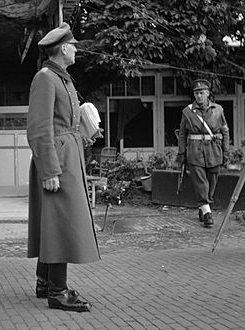
General Reichelt.
Johannes Albrecht Blaskowitz (10 July 1883 - 5 February 1948) was a German Generaloberst during World War II. He was a recipient of the Knight's Cross of the Iron Cross with Oak Leaves and Swords. After joining the Imperial German Army in 1901, Blaskowitz served throughout World War I, where he earned an Iron Cross for bravery.
During WWII, Blaskowitz led the 8th Army during the Invasion of Poland and was the Commander in Chief of Occupied Poland from 1939 to 1940. He wrote several memoranda to the German high command speaking out against SS atrocities, and he handed out death sentences to SS members for crimes against Polish civilians. Based upon these actions against the SS, Adolf Hitler personally limited Blaskowitz's future advancement. He commanded Army Group G during the Allied invasion of Southern France and Operation Nordwind, the last major German offensive of World War II on the Western Front. Blaskowitz later commanded the remnants of Army Group H as it withdrew to Northern Netherlands before surrendering to Allied forces.
After the war, he was charged with war crimes in the High Command Trial at Nuremberg. He died by suicide during the trial on 5 February 1948.
Johannes Blaskowitz was born on 10 July 1883 in the village of Paterswalde, (East Prussia), Germany (now Bolshaya Polyana in the Kaliningrad Oblast, Russia). He was the son of a Protestant pastor, Hermann Blaskowitz, and his wife Marie Blaskowitz, née Kuhn. In 1894, Blaskowitz joined cadet school at Köslin (now Koszalin, Poland) and afterwards at Berlin Lichterfelde. In 1901, he started his military career as a supreme officer candidate cadet in an East Prussian regiment in Osterode (Polish: Ostróda).
During World War I, Blaskowitz served on the Eastern and Western Fronts and was employed in the General Staff. He rose to command an infantry company by 1918, and was awarded the Iron Cross for bravery.
Blaskowitz's war service secured him a place in the small postwar Reichswehr during the Weimar Republic, through whose ranks he rose to the rank of General. His attitude towards the Nazis' seizure of power in 1933 was reportedly indifferent because he believed that the armed forces should be "politically neutral".
In early 1939 he commanded the German forces that occupied Czechoslovakia, and was promoted to General of Infantry and given command of the 8th Army just prior to the outbreak of World War II.
During the invasion of Poland, the 8th Army under Blaskowitz's command was responsible for the northern part of the front under Army Group South, led by Gerd von Rundstedt. The 8th Army saw heavy combat during the Battle of the Bzura and later besieged the Polish capital of Warsaw. On 28 September 1939, Blaskowitz accepted the surrender of General Tadeusz Kutrzeba and the Polish forces in Warsaw. After the campaign, he was awarded the Knight's Cross of the Iron Cross, promoted to Generaloberst and appointed as Commander-in-Chief East in Poland on 20 October 1939.
As a traditional soldier, Blaskowitz kept firm control on the men under his command in their dealings with civilians and was opposed to Army participation in war crimes by the SS and Einsatzgruppen. He handed out death sentences to members of the SS for crimes against the civilian population, which were rescinded by Adolf Hitler. Between November 1939 and February 1940 he wrote several memoranda to higher military officials, in which he detailed SS atrocities in Poland, their negative effects on Wehrmacht soldiers, the insolent attitude of the SS toward the army and warned that the SS "might later turn against their own people in the same way." However, his protests failed to produce results, and merely earned him the enmity of Hitler, Hans Frank, Reinhard Heydrich and Heinrich Himmler, while Chief of Staff Alfred Jodl dismissed them as naive and "uncalled for".
Commander-in-Chief Walther von Brauchitsch forwarded Blaskowitz's first memorandum to Hitler on 18 November, who launched a tirade against Blaskowitz, denouncing his concerns about due process as "childish" and poured scorn on his "Salvation Army attitude." In February 1940, Blaskowitz prepared a list of 33 complaints against the SS. Among his complaints were strip searches and rape of Jewish women, a whipping orgy in Nasielsk affecting 1,600 Jews, and a clear case of race mixing committed by a junior SS officer. Blaskowitz concluded that "It is a mistake to massacre some 10,000 Jews and Poles, as is being done at present; for-so far as the mass of the population is concerned-this will not eradicate the idea of a Polish state, nor will the Jews be exterminated." Blaskowitz was relieved of his command on 29 May 1940. Having thus encountered Hitler's wrath, Blaskowitz was the only Generaloberst at that time who was not promoted to Generalfeldmarschall in summer 1940 after the fall of France.
Following the Fall of France in May 1940, Blaskowitz was initially slated to command the 9th Army for occupation duties, but the appointment was blocked by Hitler and instead he was appointed to a relatively minor position as Military Governor of Northern France, a position he held until October 1940, when he was transferred to the command of the 1st Army, on the southwest coast between Brittany and the Pyrenees.
On 10 November 1942, the 1st and 7th Army under Blaskowitz's command launched Case Anton, the military occupation of Vichy France. The 1st Army advanced from the Atlantic coast, parallel to the Spanish border, while the 7th Army advanced from central France towards Vichy and Toulon. The 50,000-strong Vichy French Army took defensive positions around Toulon, but when confronted by German demands to disband, it did so since it lacked the military capability to resist. By the evening of 11 November, German tanks had reached the Mediterranean coast. Anton marked the end of the Vichy regime as a nominally independent state. However, Blaskowitz's forces failed to secure the Vichy French fleet at Toulon, which was scuttled by the French.
In May 1944, following the appointment of Gerd von Rundstedt as Commander-in-Chief in the West, Blaskowitz was appointed the head of Army Group G. This comparatively small command, consisting of the 1st Army and the 19th Army, was given the task of defending southern France from the imminent Allied invasion. When in Normandy, he managed to convince Field Marshal Erwin Rommel that the "rumours" Rommel had heard about atrocities on the Eastern Front were actually true.
According to historian Christopher Clark, in France, Blaskowitz tried to "build a constructive relationship with the local population", even though the conditions for him to do so were worse than in Poland. He encouraged the troops deployed to support French agriculture to act "selflessly". On the one hand, he tried to ensure that German counterinsurgency would be conducted in accordance with international norms as far as possible. He publicly distanced himself from units that committed the Oradour-sur-Glane massacre. On the other hand, when the prefects in Toulouse complained about crimes against civilians in "counter-terrorism" procedures conducted by the SS, Blaskowitz defended the right of the German army to defend itself, even though he admitted sometimes innocent people were harmed: "..He recommended that the French authorities be told that "it is imperative that innocent people sometimes fall victim to the bullet [...]. Against such a struggle [namely on the part of the partisans of the Resistance], the Wehrmacht must and will defend itself under all the means of power at its disposal." After the July Bomb Plot, he sent a note that proclaimed loyalty to Hitler. Clark speculates that he might have feared that he was suspected. There was no evidence that suggests Blaskowitz ever protested the deportation of Jews from France. Although army appraisal forms, compiled by Rundstedt, described him as a National Socialist, Christopher Clark opines that Blaskowitz likely never had any ideological attachment to Nazism. According to Clark, professionalism enabled Blaskowitz to follow his own principles even against the political Zeitgeist, but the same professionalism made him unsuitable for political resistance. After a visit in October 1943, German resistance member Ulrich von Hassell lamented that it was not fruitful to discuss with Blaskowitz who saw everything from a military point-of-view. From this "very bounded standpoint", whatever one thought about the regime's moral character became overshadowed by duty to his superiors and his troops, as well as the people whose fate "now hung in balance."
The invasion of southern France commenced on 15 August 1944, with Operation Dragoon, when Allied forces landed on the Riviera between Toulon and Cannes. Blaskowitz, though badly outnumbered and lacking air defence, brought up troops, stabilized the front, and led a fighting withdrawal to the north to avoid encirclement. U.S. Army units pursued Blaskowitz's forces up through the Vosges mountains before pausing to regroup and refuel. There, Blaskowitz's troops were reinforced by the 5th Panzer Army under Hasso von Manteuffel. Blaskowitz wanted to entrench his forces, but Hitler ordered him to immediately counterattack the U.S. Third Army. Both Manteuffel and Blaskowitz realized the futility of such an action, but obeyed orders, and their attack caught U.S. forces in disarray and pushed them back to near Lunéville on 18-20 September 1944, at which point resistance stiffened and the attack was suspended. As a result, Hitler summarily relieved Blaskowitz, replacing him with Hermann Balck.
In December 1944, Blaskowitz was recalled to his previous command and ordered to attack in the vicinity of Alsace-Lorraine in support of the ongoing Ardennes offensive. On 1 January 1945 Army Group G engaged the U.S. 7th Army during Operation Nordwind, forcing them to withdraw.
Blaskowitz was subsequently transferred to the Netherlands, where he succeeded Kurt Student as commander of Army Group H. For the following three months he conducted a fighting withdrawal against the British 2nd Army, and was awarded the Swords to his Knight's Cross. This command was redesignated in early April 1945 and Blaskowitz became commander-in-chief of the northern (still occupied) part of the Netherlands. During the Dutch famine of 1944-45, Blaskowitz allowed air corridors for Allied airdrops of food and medicine to the Dutch civilian population.
On 5 May Blaskowitz was summoned to the Hotel de Wereld in Wageningen by Lieutenant-General Charles Foulkes, (commander of I Canadian Corps), to discuss the surrender of the German forces in the Netherlands. Prince Bernhard, acting as commander-in-chief of the Dutch Interior Forces, attended the meeting. Blaskowitz agreed with all proposals by Foulkes. However, nowhere in the building - some sources say nowhere in the whole town - could a typewriter be found. Thus, the surrender document could not be typed. The next day, both parties returned and, in the presence of both Foulkes and Prince Bernhard, Blaskowitz signed the surrender document, which in the meantime had been typed.
Blaskowitz was tried for war crimes at the High Command Trial (Case No. 12), one of the subsequent Nuremberg trials. In one notorious case he was accused of ordering the execution of two deserters after the German surrender. He died by suicide on 5 February 1948. After breaking away from his guards, he jumped off a balcony into the inner courtyard of the court building.
According to Hans Laternser, the defence council for the lead defendant Wilhelm von Leeb, the prosecution told him, "Blaskowitz did not need to do that as he would certainly have been acquitted". That led to Laternser questioning the indictment. According to Clark, Blaskowitz could have counted on an acquittal. In the historian Norbert Frei's book on the elites of Nazi Germany, it is stated that the Nuremberg judges expressly saw Blaskowitz as a positive example of how Wehrmacht officers could have behaved.
Both the indictment and the suicide have been considered an enigma by scholars ever since because he likely would have been acquitted on all counts and had been told by his defence to expect to be acquitted.
Source: Wikipedia.
During WWII, Blaskowitz led the 8th Army during the Invasion of Poland and was the Commander in Chief of Occupied Poland from 1939 to 1940. He wrote several memoranda to the German high command speaking out against SS atrocities, and he handed out death sentences to SS members for crimes against Polish civilians. Based upon these actions against the SS, Adolf Hitler personally limited Blaskowitz's future advancement. He commanded Army Group G during the Allied invasion of Southern France and Operation Nordwind, the last major German offensive of World War II on the Western Front. Blaskowitz later commanded the remnants of Army Group H as it withdrew to Northern Netherlands before surrendering to Allied forces.
After the war, he was charged with war crimes in the High Command Trial at Nuremberg. He died by suicide during the trial on 5 February 1948.
Johannes Blaskowitz was born on 10 July 1883 in the village of Paterswalde, (East Prussia), Germany (now Bolshaya Polyana in the Kaliningrad Oblast, Russia). He was the son of a Protestant pastor, Hermann Blaskowitz, and his wife Marie Blaskowitz, née Kuhn. In 1894, Blaskowitz joined cadet school at Köslin (now Koszalin, Poland) and afterwards at Berlin Lichterfelde. In 1901, he started his military career as a supreme officer candidate cadet in an East Prussian regiment in Osterode (Polish: Ostróda).
During World War I, Blaskowitz served on the Eastern and Western Fronts and was employed in the General Staff. He rose to command an infantry company by 1918, and was awarded the Iron Cross for bravery.
Blaskowitz's war service secured him a place in the small postwar Reichswehr during the Weimar Republic, through whose ranks he rose to the rank of General. His attitude towards the Nazis' seizure of power in 1933 was reportedly indifferent because he believed that the armed forces should be "politically neutral".
In early 1939 he commanded the German forces that occupied Czechoslovakia, and was promoted to General of Infantry and given command of the 8th Army just prior to the outbreak of World War II.
During the invasion of Poland, the 8th Army under Blaskowitz's command was responsible for the northern part of the front under Army Group South, led by Gerd von Rundstedt. The 8th Army saw heavy combat during the Battle of the Bzura and later besieged the Polish capital of Warsaw. On 28 September 1939, Blaskowitz accepted the surrender of General Tadeusz Kutrzeba and the Polish forces in Warsaw. After the campaign, he was awarded the Knight's Cross of the Iron Cross, promoted to Generaloberst and appointed as Commander-in-Chief East in Poland on 20 October 1939.
As a traditional soldier, Blaskowitz kept firm control on the men under his command in their dealings with civilians and was opposed to Army participation in war crimes by the SS and Einsatzgruppen. He handed out death sentences to members of the SS for crimes against the civilian population, which were rescinded by Adolf Hitler. Between November 1939 and February 1940 he wrote several memoranda to higher military officials, in which he detailed SS atrocities in Poland, their negative effects on Wehrmacht soldiers, the insolent attitude of the SS toward the army and warned that the SS "might later turn against their own people in the same way." However, his protests failed to produce results, and merely earned him the enmity of Hitler, Hans Frank, Reinhard Heydrich and Heinrich Himmler, while Chief of Staff Alfred Jodl dismissed them as naive and "uncalled for".
Commander-in-Chief Walther von Brauchitsch forwarded Blaskowitz's first memorandum to Hitler on 18 November, who launched a tirade against Blaskowitz, denouncing his concerns about due process as "childish" and poured scorn on his "Salvation Army attitude." In February 1940, Blaskowitz prepared a list of 33 complaints against the SS. Among his complaints were strip searches and rape of Jewish women, a whipping orgy in Nasielsk affecting 1,600 Jews, and a clear case of race mixing committed by a junior SS officer. Blaskowitz concluded that "It is a mistake to massacre some 10,000 Jews and Poles, as is being done at present; for-so far as the mass of the population is concerned-this will not eradicate the idea of a Polish state, nor will the Jews be exterminated." Blaskowitz was relieved of his command on 29 May 1940. Having thus encountered Hitler's wrath, Blaskowitz was the only Generaloberst at that time who was not promoted to Generalfeldmarschall in summer 1940 after the fall of France.
Following the Fall of France in May 1940, Blaskowitz was initially slated to command the 9th Army for occupation duties, but the appointment was blocked by Hitler and instead he was appointed to a relatively minor position as Military Governor of Northern France, a position he held until October 1940, when he was transferred to the command of the 1st Army, on the southwest coast between Brittany and the Pyrenees.
On 10 November 1942, the 1st and 7th Army under Blaskowitz's command launched Case Anton, the military occupation of Vichy France. The 1st Army advanced from the Atlantic coast, parallel to the Spanish border, while the 7th Army advanced from central France towards Vichy and Toulon. The 50,000-strong Vichy French Army took defensive positions around Toulon, but when confronted by German demands to disband, it did so since it lacked the military capability to resist. By the evening of 11 November, German tanks had reached the Mediterranean coast. Anton marked the end of the Vichy regime as a nominally independent state. However, Blaskowitz's forces failed to secure the Vichy French fleet at Toulon, which was scuttled by the French.
In May 1944, following the appointment of Gerd von Rundstedt as Commander-in-Chief in the West, Blaskowitz was appointed the head of Army Group G. This comparatively small command, consisting of the 1st Army and the 19th Army, was given the task of defending southern France from the imminent Allied invasion. When in Normandy, he managed to convince Field Marshal Erwin Rommel that the "rumours" Rommel had heard about atrocities on the Eastern Front were actually true.
According to historian Christopher Clark, in France, Blaskowitz tried to "build a constructive relationship with the local population", even though the conditions for him to do so were worse than in Poland. He encouraged the troops deployed to support French agriculture to act "selflessly". On the one hand, he tried to ensure that German counterinsurgency would be conducted in accordance with international norms as far as possible. He publicly distanced himself from units that committed the Oradour-sur-Glane massacre. On the other hand, when the prefects in Toulouse complained about crimes against civilians in "counter-terrorism" procedures conducted by the SS, Blaskowitz defended the right of the German army to defend itself, even though he admitted sometimes innocent people were harmed: "..He recommended that the French authorities be told that "it is imperative that innocent people sometimes fall victim to the bullet [...]. Against such a struggle [namely on the part of the partisans of the Resistance], the Wehrmacht must and will defend itself under all the means of power at its disposal." After the July Bomb Plot, he sent a note that proclaimed loyalty to Hitler. Clark speculates that he might have feared that he was suspected. There was no evidence that suggests Blaskowitz ever protested the deportation of Jews from France. Although army appraisal forms, compiled by Rundstedt, described him as a National Socialist, Christopher Clark opines that Blaskowitz likely never had any ideological attachment to Nazism. According to Clark, professionalism enabled Blaskowitz to follow his own principles even against the political Zeitgeist, but the same professionalism made him unsuitable for political resistance. After a visit in October 1943, German resistance member Ulrich von Hassell lamented that it was not fruitful to discuss with Blaskowitz who saw everything from a military point-of-view. From this "very bounded standpoint", whatever one thought about the regime's moral character became overshadowed by duty to his superiors and his troops, as well as the people whose fate "now hung in balance."
The invasion of southern France commenced on 15 August 1944, with Operation Dragoon, when Allied forces landed on the Riviera between Toulon and Cannes. Blaskowitz, though badly outnumbered and lacking air defence, brought up troops, stabilized the front, and led a fighting withdrawal to the north to avoid encirclement. U.S. Army units pursued Blaskowitz's forces up through the Vosges mountains before pausing to regroup and refuel. There, Blaskowitz's troops were reinforced by the 5th Panzer Army under Hasso von Manteuffel. Blaskowitz wanted to entrench his forces, but Hitler ordered him to immediately counterattack the U.S. Third Army. Both Manteuffel and Blaskowitz realized the futility of such an action, but obeyed orders, and their attack caught U.S. forces in disarray and pushed them back to near Lunéville on 18-20 September 1944, at which point resistance stiffened and the attack was suspended. As a result, Hitler summarily relieved Blaskowitz, replacing him with Hermann Balck.
In December 1944, Blaskowitz was recalled to his previous command and ordered to attack in the vicinity of Alsace-Lorraine in support of the ongoing Ardennes offensive. On 1 January 1945 Army Group G engaged the U.S. 7th Army during Operation Nordwind, forcing them to withdraw.
Blaskowitz was subsequently transferred to the Netherlands, where he succeeded Kurt Student as commander of Army Group H. For the following three months he conducted a fighting withdrawal against the British 2nd Army, and was awarded the Swords to his Knight's Cross. This command was redesignated in early April 1945 and Blaskowitz became commander-in-chief of the northern (still occupied) part of the Netherlands. During the Dutch famine of 1944-45, Blaskowitz allowed air corridors for Allied airdrops of food and medicine to the Dutch civilian population.
On 5 May Blaskowitz was summoned to the Hotel de Wereld in Wageningen by Lieutenant-General Charles Foulkes, (commander of I Canadian Corps), to discuss the surrender of the German forces in the Netherlands. Prince Bernhard, acting as commander-in-chief of the Dutch Interior Forces, attended the meeting. Blaskowitz agreed with all proposals by Foulkes. However, nowhere in the building - some sources say nowhere in the whole town - could a typewriter be found. Thus, the surrender document could not be typed. The next day, both parties returned and, in the presence of both Foulkes and Prince Bernhard, Blaskowitz signed the surrender document, which in the meantime had been typed.
Blaskowitz was tried for war crimes at the High Command Trial (Case No. 12), one of the subsequent Nuremberg trials. In one notorious case he was accused of ordering the execution of two deserters after the German surrender. He died by suicide on 5 February 1948. After breaking away from his guards, he jumped off a balcony into the inner courtyard of the court building.
According to Hans Laternser, the defence council for the lead defendant Wilhelm von Leeb, the prosecution told him, "Blaskowitz did not need to do that as he would certainly have been acquitted". That led to Laternser questioning the indictment. According to Clark, Blaskowitz could have counted on an acquittal. In the historian Norbert Frei's book on the elites of Nazi Germany, it is stated that the Nuremberg judges expressly saw Blaskowitz as a positive example of how Wehrmacht officers could have behaved.
Both the indictment and the suicide have been considered an enigma by scholars ever since because he likely would have been acquitted on all counts and had been told by his defence to expect to be acquitted.
Source: Wikipedia.
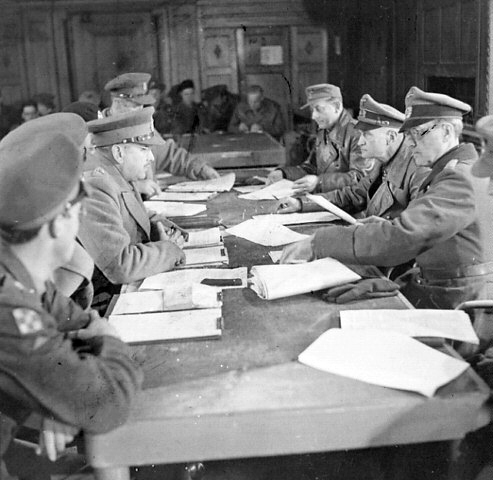
Capitulation conference.
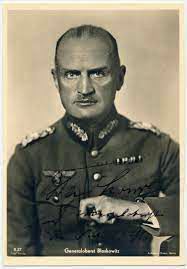
General Blaskowitz.
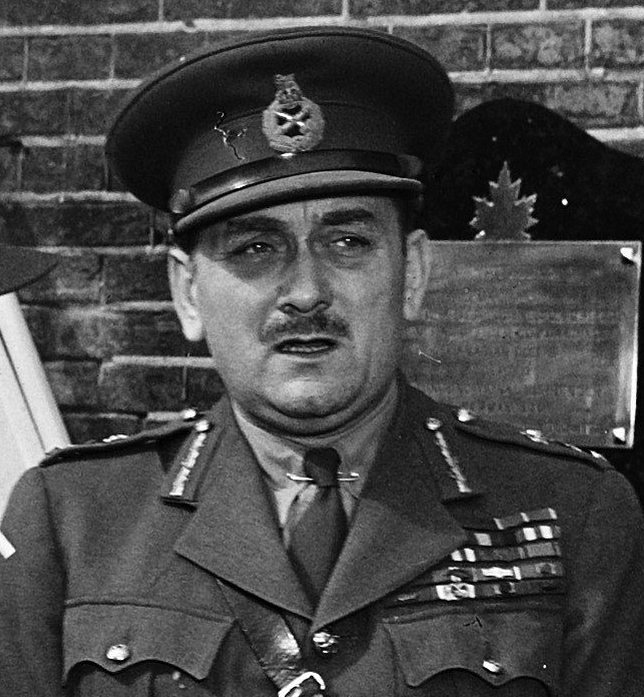
General Foulkes.
Charles Foulkes, CC, CB, CBE, DSO, CD (3 January 1903 - 12 September 1969) was a British-Canadian soldier, and an officer of The Royal Canadian Regiment.
One of eight children, Foulkes was born in Stockton-on-Tees, England, on 3 January 1903. His family moved to Canada, eventually settling at 230 Hill Street in London, Ontario. He completed his secondary school education at the London Collegiate Institute before going to the University of Western Ontario.
He joined the Canadian Militia in 1926. In 1937 he attended the Staff College in Camberley, England. His report concluded that he was, "Sound and competent, and possessed of drive and determination."
At the outbreak of the Second World War in September 1939, Foulkes was serving as a major with the 3rd Canadian Infantry Brigade of the 1st Canadian Infantry Division. He went on to be a General Staff Officer with 3rd Canadian Infantry Division. After serving as the 3rd Brigade's commander from August 1942, he was appointed General Officer Commanding (GOC) of the 2nd Canadian Infantry Division in January 1944 and led the division through the Normandy Campaign. In November 1944 he was made General Officer Commanding I Canadian Corps in Italy before it returned to Northwest Europe in early 1945. He received rapid promotion during the war, rising from major in 1939 to lieutenant-general in 1944.
On 4 May 1945, south of Hamburg, Field Marshal Sir Bernard Law Montgomery accepted the unconditional surrender of the German forces in the Netherlands, northwest Germany including all islands, in Denmark and all naval ships in those areas. The surrender preceded the end of World War II in Europe and was signed in a carpeted tent at Montgomery's headquarters on the Timeloberg hill at Wendisch Evern.
On 5 May 1945, Foulkes summoned German General Blaskowitz to the Hotel de Wereld in Wageningen to discuss the surrender of German forces in the Netherlands. His Royal Highness Prince Bernhard, acting as commander in chief of the Dutch Interior Forces, attended the meeting as well. Blaskowitz agreed with all of the proposals made by Foulkes. However, nowhere in the building - some sources claim: nowhere in the whole town - could a typewriter be found. Thus the surrender document could not be typed. The next day, 6 May, both parties returned, and in the presence of both General Foulkes and Prince Bernhard, Blaskowitz signed the surrender document which in the meantime had been typed.
After the war, Foulkes was appointed Chief of the General Staff (CGS) and, in 1951, the year he was promoted to full general, the first Chairman of the Chiefs of Staff Committee. General Guy Simonds as army chief clashed with Foulkes about where to station the newly-envisaged Canadian force in West Germany. The continentalist Foulkes, who wanted to move Canada closer to the United States, wanted the Canadians to serve with the U.S Army forces in southern West Germany. Simonds by contrast argued that for historical reasons the Canadians should serve with the British forces in northern West Germany, arguing that the Canadians would fight better with them if the Soviet Ground Forces and their Eastern European satellites should invade West Germany. Simonds stated that the Canadians had fought alongside the British successively in the Boer War, the First World War, the Second World War, and the Korean War, and moreover the Canadian Army was closely modelled after the British Army right down to having British-style uniforms and ranks and the same regimental structure; for all these reasons, Simonds felt that placing the Canadians with the British in northern West Germany would be a better fit. As the Canadian decision-makers had been "shocked by the American performance in Korea" while the British forces fighting in Korea had fought well, Simonds won the debate and it was agreed that the Canadians would serve as part of the British Army of the Rhine, though Foulkes was able to ensure the Royal Canadian Air Force (RCAF) units would serve with the United States Air Force instead of the Royal Air Force.
Foulkes retired in 1960.
In 1968 he was made a Companion of the Order of Canada. He taught at Carleton University in 1968 and 1969. He died in Ottawa in 1969.
His medals and other personal artifacts are on display at the Royal Canadian Regiment Museum in London, Ontario. He was awarded the Honorary degree of Doctor of Laws (LL.D) from the University of Western Ontario on 11 June 1947.
Source: Wikipedia.
One of eight children, Foulkes was born in Stockton-on-Tees, England, on 3 January 1903. His family moved to Canada, eventually settling at 230 Hill Street in London, Ontario. He completed his secondary school education at the London Collegiate Institute before going to the University of Western Ontario.
He joined the Canadian Militia in 1926. In 1937 he attended the Staff College in Camberley, England. His report concluded that he was, "Sound and competent, and possessed of drive and determination."
At the outbreak of the Second World War in September 1939, Foulkes was serving as a major with the 3rd Canadian Infantry Brigade of the 1st Canadian Infantry Division. He went on to be a General Staff Officer with 3rd Canadian Infantry Division. After serving as the 3rd Brigade's commander from August 1942, he was appointed General Officer Commanding (GOC) of the 2nd Canadian Infantry Division in January 1944 and led the division through the Normandy Campaign. In November 1944 he was made General Officer Commanding I Canadian Corps in Italy before it returned to Northwest Europe in early 1945. He received rapid promotion during the war, rising from major in 1939 to lieutenant-general in 1944.
On 4 May 1945, south of Hamburg, Field Marshal Sir Bernard Law Montgomery accepted the unconditional surrender of the German forces in the Netherlands, northwest Germany including all islands, in Denmark and all naval ships in those areas. The surrender preceded the end of World War II in Europe and was signed in a carpeted tent at Montgomery's headquarters on the Timeloberg hill at Wendisch Evern.
On 5 May 1945, Foulkes summoned German General Blaskowitz to the Hotel de Wereld in Wageningen to discuss the surrender of German forces in the Netherlands. His Royal Highness Prince Bernhard, acting as commander in chief of the Dutch Interior Forces, attended the meeting as well. Blaskowitz agreed with all of the proposals made by Foulkes. However, nowhere in the building - some sources claim: nowhere in the whole town - could a typewriter be found. Thus the surrender document could not be typed. The next day, 6 May, both parties returned, and in the presence of both General Foulkes and Prince Bernhard, Blaskowitz signed the surrender document which in the meantime had been typed.
After the war, Foulkes was appointed Chief of the General Staff (CGS) and, in 1951, the year he was promoted to full general, the first Chairman of the Chiefs of Staff Committee. General Guy Simonds as army chief clashed with Foulkes about where to station the newly-envisaged Canadian force in West Germany. The continentalist Foulkes, who wanted to move Canada closer to the United States, wanted the Canadians to serve with the U.S Army forces in southern West Germany. Simonds by contrast argued that for historical reasons the Canadians should serve with the British forces in northern West Germany, arguing that the Canadians would fight better with them if the Soviet Ground Forces and their Eastern European satellites should invade West Germany. Simonds stated that the Canadians had fought alongside the British successively in the Boer War, the First World War, the Second World War, and the Korean War, and moreover the Canadian Army was closely modelled after the British Army right down to having British-style uniforms and ranks and the same regimental structure; for all these reasons, Simonds felt that placing the Canadians with the British in northern West Germany would be a better fit. As the Canadian decision-makers had been "shocked by the American performance in Korea" while the British forces fighting in Korea had fought well, Simonds won the debate and it was agreed that the Canadians would serve as part of the British Army of the Rhine, though Foulkes was able to ensure the Royal Canadian Air Force (RCAF) units would serve with the United States Air Force instead of the Royal Air Force.
Foulkes retired in 1960.
In 1968 he was made a Companion of the Order of Canada. He taught at Carleton University in 1968 and 1969. He died in Ottawa in 1969.
His medals and other personal artifacts are on display at the Royal Canadian Regiment Museum in London, Ontario. He was awarded the Honorary degree of Doctor of Laws (LL.D) from the University of Western Ontario on 11 June 1947.
Source: Wikipedia.
The following are personal notes by H.R.H. PRINCE BERNHARD on the problems which had to be coped with:
I realized from the start that it was an impossible thing to ask the Resistance Forces to leave their arms at home, not so much in view of the Germans still being armed, but of the Gestapo,, S.D. collaborators, etc. They would feel completely powerless, which would be too much for a man who has been a good Dutchman.
In view of the fact that it was reliably reported that SD agents and Landwacht were using orange arm bands and possibly the same as Resistance, measures had to be taken in order to ensure that the confusion should not become greater. Therefore, new arm bands were the only logical solution and we naturally complied with the Corps' Commander's wishes in this matter.
I Realized that many of the Resistance personnel would perhaps not understand any of these difficulties, neither would they understand my position. They should realise, however, that as soldiers they, as well as I, had to carry out orders issued to us, however unpleasant they might be.
All of my Staff Officers and myself have taken every available opportunity to make clear to the Allied Commanders the psychological difficult situation in which the Interior Forces found themselves. This was fully understood by these Commanders.
O.C.M.E. 27 (SPECIAL FORCES MISSION NETHERLANS) PROCEEDS OVERSEAS.
In view of the general situation, Lt.Col. DOBSON Proceed overseas on the 4th May 1945 and temporarily joined 2 Special Forces Detachment, then situated at HARSKAMP, South West of APELDOORN, with a view to establishing the MISSION when this became possible..
At that time the situation was still rather hectic, food had been dropped to the famine stricken areas and by special arrangement with the Germans, lorries containing food were being driven through the GREBBE LINE into Western Holland. Some of these lorries were attacked , it is believed by Dutch SS. Some German Elements were still in a dangerous mood and reports of continued flooding came through. In the meantime the CBS (Koot) and SWISH (Borghouts) had made a agreement with the German SD that if further sabotage etc were stopped, they would stop all further executions and political prisoners would be released.
Instructions to the Resistance Forces forbidden them to carry arms in the streets was well adhered to and there were very few incidents. The Resistance Forces were eventually issued with proper military arm bands which entitled them to be armed if on special duties appointed by the Canadian Force Commanders. These duties consisted of maintaining law and order, rounding up German stragglers, undertaking guard and point duty, arresting collaborators and guarding bridges.
The first main task was the guarding of the GREEN LINE, from the IJSSELMEER to the NEDER RHINE, in order to prevent the population from the EAST streaming over into the Western provinces where food was very scarce and to prevent possible sickness spreading back to the Eastern provinces. Special Guards were also placed on the bridges over the IJSSEL river to prevent German or collaborators escaping back to Germany in civilian clothing. It is estimated that some 20.000 to 30.000 resistance personnel were employed by the Canadians in some form or other.
When the 1st Canadian Corps set up its HQ at HILVERSUM, 2 Special Forces Detachment, moved into Utrecht on Thursday May10th and M.E.27 set up its Mission on the 12th May 1945 at Utrecht.
The Mission consisted of the following officers:
Lt. Col. R.I. DOBSON - O.C.
Major W.A. MURPHY - G.S.O.2.
Capt. A.C. KNIGHT - G.S.O. 3.
Capt. OLINK - G.S.O.3.
Capt. TIVEY - G.S.O.3.
Capt. W.E. MILLS - G.S.O.3.
Lt. GARDINER - Staff Lieutenant.
Plus Sgt. SPENCE, the Mission's wireless operator and 12 other Ranks. Major OLMSTED and Capt. MATLOCK, two O.S.S. USA Officers were also attached to the Mission.
Capt. HOOPER and Sgt. HANNAFORD who also belonged to M.E. 27 were however retained by PRINCE BERNHARD at the Royal Palace at Het Loo, APELDOORN, to maintain his wireless link on NORTHAW with the UK.
The Mission initial function was the collection of the agents who had been overrun or liberated, interrogating them and sending them to the UK., liaising with PRINCE BERNHARD, SHAEF Mission to the Netherlands, Netherlands District, BBO and the SIS Mission at The Hague. Redundant wireless material was collected throughout Holland and all Regional Commanders and their areas visited.
JUNE & JULY 1945.
Brigadier MOCKLER FERRYMAN, C.B.E.M.C. accompanied by Mr. MILLAR and Major WILLARD of OSS visited the Mission on the 6th June and remained until the 9th June. On the morning of the 7th June the visitors inspected the famous local Resistance sights of interest in UTRECHT, including the famous underground telephone exchange used during the German occupation. They returned to the Mission for a luncheon party which was attended by:
Lieut. General H.R.H. Prince Bernhard of The Netherlands.
Major General Koot - CBS
Brigadier Mockler Ferryman - SF-HQ
Mr. Millar - OSS.
Lt.Col. DE Rome - O.C. 2 SF Det.
Lt.Col. R.I. Dobson - O.C. ME 27.
Lt. Col. Van Houten - Prince Bernhard's Staff.
Lt. Col. Six NBS HQ Amsterdam.
Lt.Col. Klijzing - BBO.
Major P. Borghouts - Agent SWISH, Deputy CBS.
Major De Boei - Delta Centrum.
Capt. Tivey - Adjutant ME 27.
This was followed by a small ceremony during which the agent Lt. De Goede (@ RUMMY) was invested with the order of the M.B.E. (Military) by Brigadier Mockler-Ferryman.
In the afternoon a reception was held at the Mission HQ which was attended by all the principal Resistance personalities throughout Holland and also the following:
Lieut. General H.R.H. Prince Bernhard.
Lieut. General Ch. Foulkes, G.O.C. 1st Canadian Corps.
The Regional Commanders and one saboteur leader of each of the 13 NBS Regions.
Staff Officers of Prince Bernhard.
Staff Officers of the BBO.
Staff Officers of ME 27 and 2 SF Detachment.
On Friday 8th June, Brigadier Mockler-Ferryman and party accompanied by Lt. Col. R.I. Dobson made an all day tour comprising visits to the Resistance HQ's at ROTTERDAM and AMSTERDAM.
The Mission completed its work of collecting surplus explosives, Regional Commanders' reports and disbanded on the 7th July 1945 and returned to the UK on 10th July.
WIRELESS COMMUNICATIONS - See APPENDIX 'A'.
TOTAL LIST OF CASUALTIES - See APPENDIX 'B'.
SABOTAGE SUMMARY - See APPENDIC 'C'.
STORES DELIVERY SUMMARY - See APPENDIX 'D'.
SUMMARY OF DUTCH SECTION PERSONNEL - JAN 1944 / AUG 1945 - See APPENDIX 'E'.
FINANCIAL REPORT OF OPERATIONAL CURRENCIES ISSUED - JAN 1944 / MAY 1945 - See APPENDIX 'F'.
AGENTS SENT AND/OR DROPPED IN HOLLAND JAN 1944 / APR 1945 - See APPENDIX 'G'.
w.mugge@home.nl
I realized from the start that it was an impossible thing to ask the Resistance Forces to leave their arms at home, not so much in view of the Germans still being armed, but of the Gestapo,, S.D. collaborators, etc. They would feel completely powerless, which would be too much for a man who has been a good Dutchman.
In view of the fact that it was reliably reported that SD agents and Landwacht were using orange arm bands and possibly the same as Resistance, measures had to be taken in order to ensure that the confusion should not become greater. Therefore, new arm bands were the only logical solution and we naturally complied with the Corps' Commander's wishes in this matter.
I Realized that many of the Resistance personnel would perhaps not understand any of these difficulties, neither would they understand my position. They should realise, however, that as soldiers they, as well as I, had to carry out orders issued to us, however unpleasant they might be.
All of my Staff Officers and myself have taken every available opportunity to make clear to the Allied Commanders the psychological difficult situation in which the Interior Forces found themselves. This was fully understood by these Commanders.
O.C.M.E. 27 (SPECIAL FORCES MISSION NETHERLANS) PROCEEDS OVERSEAS.
In view of the general situation, Lt.Col. DOBSON Proceed overseas on the 4th May 1945 and temporarily joined 2 Special Forces Detachment, then situated at HARSKAMP, South West of APELDOORN, with a view to establishing the MISSION when this became possible..
At that time the situation was still rather hectic, food had been dropped to the famine stricken areas and by special arrangement with the Germans, lorries containing food were being driven through the GREBBE LINE into Western Holland. Some of these lorries were attacked , it is believed by Dutch SS. Some German Elements were still in a dangerous mood and reports of continued flooding came through. In the meantime the CBS (Koot) and SWISH (Borghouts) had made a agreement with the German SD that if further sabotage etc were stopped, they would stop all further executions and political prisoners would be released.
Instructions to the Resistance Forces forbidden them to carry arms in the streets was well adhered to and there were very few incidents. The Resistance Forces were eventually issued with proper military arm bands which entitled them to be armed if on special duties appointed by the Canadian Force Commanders. These duties consisted of maintaining law and order, rounding up German stragglers, undertaking guard and point duty, arresting collaborators and guarding bridges.
The first main task was the guarding of the GREEN LINE, from the IJSSELMEER to the NEDER RHINE, in order to prevent the population from the EAST streaming over into the Western provinces where food was very scarce and to prevent possible sickness spreading back to the Eastern provinces. Special Guards were also placed on the bridges over the IJSSEL river to prevent German or collaborators escaping back to Germany in civilian clothing. It is estimated that some 20.000 to 30.000 resistance personnel were employed by the Canadians in some form or other.
When the 1st Canadian Corps set up its HQ at HILVERSUM, 2 Special Forces Detachment, moved into Utrecht on Thursday May10th and M.E.27 set up its Mission on the 12th May 1945 at Utrecht.
The Mission consisted of the following officers:
Lt. Col. R.I. DOBSON - O.C.
Major W.A. MURPHY - G.S.O.2.
Capt. A.C. KNIGHT - G.S.O. 3.
Capt. OLINK - G.S.O.3.
Capt. TIVEY - G.S.O.3.
Capt. W.E. MILLS - G.S.O.3.
Lt. GARDINER - Staff Lieutenant.
Plus Sgt. SPENCE, the Mission's wireless operator and 12 other Ranks. Major OLMSTED and Capt. MATLOCK, two O.S.S. USA Officers were also attached to the Mission.
Capt. HOOPER and Sgt. HANNAFORD who also belonged to M.E. 27 were however retained by PRINCE BERNHARD at the Royal Palace at Het Loo, APELDOORN, to maintain his wireless link on NORTHAW with the UK.
The Mission initial function was the collection of the agents who had been overrun or liberated, interrogating them and sending them to the UK., liaising with PRINCE BERNHARD, SHAEF Mission to the Netherlands, Netherlands District, BBO and the SIS Mission at The Hague. Redundant wireless material was collected throughout Holland and all Regional Commanders and their areas visited.
JUNE & JULY 1945.
Brigadier MOCKLER FERRYMAN, C.B.E.M.C. accompanied by Mr. MILLAR and Major WILLARD of OSS visited the Mission on the 6th June and remained until the 9th June. On the morning of the 7th June the visitors inspected the famous local Resistance sights of interest in UTRECHT, including the famous underground telephone exchange used during the German occupation. They returned to the Mission for a luncheon party which was attended by:
Lieut. General H.R.H. Prince Bernhard of The Netherlands.
Major General Koot - CBS
Brigadier Mockler Ferryman - SF-HQ
Mr. Millar - OSS.
Lt.Col. DE Rome - O.C. 2 SF Det.
Lt.Col. R.I. Dobson - O.C. ME 27.
Lt. Col. Van Houten - Prince Bernhard's Staff.
Lt. Col. Six NBS HQ Amsterdam.
Lt.Col. Klijzing - BBO.
Major P. Borghouts - Agent SWISH, Deputy CBS.
Major De Boei - Delta Centrum.
Capt. Tivey - Adjutant ME 27.
This was followed by a small ceremony during which the agent Lt. De Goede (@ RUMMY) was invested with the order of the M.B.E. (Military) by Brigadier Mockler-Ferryman.
In the afternoon a reception was held at the Mission HQ which was attended by all the principal Resistance personalities throughout Holland and also the following:
Lieut. General H.R.H. Prince Bernhard.
Lieut. General Ch. Foulkes, G.O.C. 1st Canadian Corps.
The Regional Commanders and one saboteur leader of each of the 13 NBS Regions.
Staff Officers of Prince Bernhard.
Staff Officers of the BBO.
Staff Officers of ME 27 and 2 SF Detachment.
On Friday 8th June, Brigadier Mockler-Ferryman and party accompanied by Lt. Col. R.I. Dobson made an all day tour comprising visits to the Resistance HQ's at ROTTERDAM and AMSTERDAM.
The Mission completed its work of collecting surplus explosives, Regional Commanders' reports and disbanded on the 7th July 1945 and returned to the UK on 10th July.
WIRELESS COMMUNICATIONS - See APPENDIX 'A'.
TOTAL LIST OF CASUALTIES - See APPENDIX 'B'.
SABOTAGE SUMMARY - See APPENDIC 'C'.
STORES DELIVERY SUMMARY - See APPENDIX 'D'.
SUMMARY OF DUTCH SECTION PERSONNEL - JAN 1944 / AUG 1945 - See APPENDIX 'E'.
FINANCIAL REPORT OF OPERATIONAL CURRENCIES ISSUED - JAN 1944 / MAY 1945 - See APPENDIX 'F'.
AGENTS SENT AND/OR DROPPED IN HOLLAND JAN 1944 / APR 1945 - See APPENDIX 'G'.
w.mugge@home.nl