
Huize DE KLEYKAMP te Den Haag
Voor de aanval van de RAF.

Tijdens de aanval met fosfor raketten.

Het resultaat, een rokende puinhoop.
w.mugge@home.nl

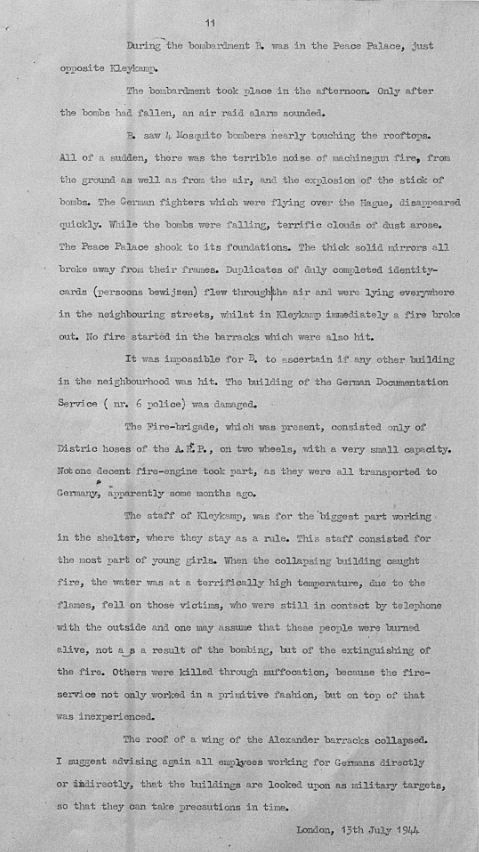
Rapport van Tobias over de aanval.
WEGGUM.COM
On April 11, 1944, the bombing of Villa Kleykamp took place. It was a military-technical success, but it came at a high cost in human lives, caused extensive material damage, and achieved only limited results in destroying the German shadow administration.
Opposite the Peace Palace, along Scheveningseweg, stood a striking building: the large white Villa Kleykamp. Until 1941, the Royal Art Gallery Kleykamp had been housed in this building.
Shadow administration by the Germans
In 1944, it served as the headquarters of the National Inspectorate of Population Registers. Large filing cabinets in the building contained approximately nine million receipts for the identity cards introduced by the German occupying forces.
The shadow administration at Villa Kleykamp contained the same information as that recorded on the original identity card, such as personal details, a photograph, and a fingerprint. The existence of these documents made it more difficult to forge identity cards. For this reason, the Dutch resistance had requested that the Allies bomb the archive.
Bombing at the request of the resistance
The Allies complied with this request. On April 11, 1944, a precision bombing raid on Villa Kleykamp was carried out. At around 2:30 p.m. that day, six De Havilland Mosquito fighter-bombers bombed the large white building.
Three-quarters of the receipts not destroyed
The bombing, carried out from low altitude, was a military-technical success: the villa was completely destroyed. However, the same could not be said for the receipts, of which an estimated three-quarters survived both the bombing and the subsequent fire. Some of the papers lay scattered among the remains of the bombed villa.
Rescuing stacks from German hands
It is known that members of the Air Protection Service, several of whom were active in the resistance, “rescued” small stacks of identity card receipts from the rubble of Kleykamp in the chaos following the bombing, removing them from the hands of the German occupiers and taking them away.
More than sixty dead
The bombing claimed more than sixty lives and left many others injured. At the time of the air raid, more than one hundred employees were working in the building. Rescue services spent a week searching for victims. The last victim was recovered from the rubble a week after the bombing.
Material damage not limited to Kleykamp
The material damage was not confined to the Kleykamp house. On Laan Copes van Cattenburch—now called Burgemeester van Karnebeeklaan—several buildings were completely destroyed (numbers 18, 20, 22, 24, and 23) or severely damaged (numbers 12, 14, 16, 21, 25, 27, 29, and 31). The old Alexander Barracks, which was in use by the German Ordnungspolizei, was also hit. In the wider area, there was extensive glass damage.
Was the bombing successful?
In England, the bombing was “celebrated” as a major success, with Dutch decorations awarded to all aircraft crews who returned safely. However, given the high human cost, the extensive material damage, and the limited success in destroying the shadow administration of the identity cards, a more nuanced assessment of the precision bombing of Kleykamp is warranted.
Opposite the Peace Palace, along Scheveningseweg, stood a striking building: the large white Villa Kleykamp. Until 1941, the Royal Art Gallery Kleykamp had been housed in this building.
Shadow administration by the Germans
In 1944, it served as the headquarters of the National Inspectorate of Population Registers. Large filing cabinets in the building contained approximately nine million receipts for the identity cards introduced by the German occupying forces.
The shadow administration at Villa Kleykamp contained the same information as that recorded on the original identity card, such as personal details, a photograph, and a fingerprint. The existence of these documents made it more difficult to forge identity cards. For this reason, the Dutch resistance had requested that the Allies bomb the archive.
Bombing at the request of the resistance
The Allies complied with this request. On April 11, 1944, a precision bombing raid on Villa Kleykamp was carried out. At around 2:30 p.m. that day, six De Havilland Mosquito fighter-bombers bombed the large white building.
Three-quarters of the receipts not destroyed
The bombing, carried out from low altitude, was a military-technical success: the villa was completely destroyed. However, the same could not be said for the receipts, of which an estimated three-quarters survived both the bombing and the subsequent fire. Some of the papers lay scattered among the remains of the bombed villa.
Rescuing stacks from German hands
It is known that members of the Air Protection Service, several of whom were active in the resistance, “rescued” small stacks of identity card receipts from the rubble of Kleykamp in the chaos following the bombing, removing them from the hands of the German occupiers and taking them away.
More than sixty dead
The bombing claimed more than sixty lives and left many others injured. At the time of the air raid, more than one hundred employees were working in the building. Rescue services spent a week searching for victims. The last victim was recovered from the rubble a week after the bombing.
Material damage not limited to Kleykamp
The material damage was not confined to the Kleykamp house. On Laan Copes van Cattenburch—now called Burgemeester van Karnebeeklaan—several buildings were completely destroyed (numbers 18, 20, 22, 24, and 23) or severely damaged (numbers 12, 14, 16, 21, 25, 27, 29, and 31). The old Alexander Barracks, which was in use by the German Ordnungspolizei, was also hit. In the wider area, there was extensive glass damage.
Was the bombing successful?
In England, the bombing was “celebrated” as a major success, with Dutch decorations awarded to all aircraft crews who returned safely. However, given the high human cost, the extensive material damage, and the limited success in destroying the shadow administration of the identity cards, a more nuanced assessment of the precision bombing of Kleykamp is warranted.