DETAILS OF THE LAST LEG OF THE JOURNEY.
In the Personal File (HS9-392-1) of François Xavier Emile Danhaive (B), it is described in considerable detail how he escaped from Belgium to Spain. From Paris onward, Tobias was his travelling companion.
On Monday, April 24th 1944, Danhaive left his hometown of Basècles and travelled to Brussels. There he stayed with Mrs. Des Essarts at 29 Longue Rue aux Bois, Brussels. On Tuesday, April 25th, at around 5:00 p.m., his hostess took him to the Café Metropolian opposite the Gare du Midi station. There he met his guide, Lucien, and Lucien’s wife. He had already received false papers from a certain Miss Carette: an identity card and a so-called Reisebescheinigung in the name of Willy Michiels. The journey to Paris went via Kortrijk, Mouscron, and Tournai.
Upon arriving in Paris, Danhaive was taken by his guide Lucien to the “Hotel de la Civette,” where he remained until Sunday, April 30rd. This may have been a safe house located above a cigar shop (Civette). Each day he reported to Miss Bellières, a niece of Jacky Des Essarts, who lived near Porte de Neuilly. On Sunday, 30 April, he met Mrs. Germaine (a courier for JULIEN = Mitterrand). This grey-haired woman of about sixty took him to the house of the widow Odette Delorme at 4 Rue Ernest Cresson, Paris. Danhaive then stayed in this safe house for 17 days, until Tuesday, May 16th 1944.
On Saturday, May 13th, Tobias Biallosterski, alias Jan, also arrived at this address. A few days later, on Tuesday, May 16th, Germaine took both men to the Gare d’Austerlitz and introduced them to the guide who would accompany them to Toulouse. The guide had with him another man who also wished to escape to Spain: the Belgian Georges Marcq. At 10:30 a.m. on Wednesday, May 17th, the group arrived at Toulouse station. Danhaive had already received in Paris a false identity card in the name of Denizot, as well as a travel document from Germaine.
"Le 13 mai 1944, est rejoint par un Hollandais J. DAUBRY (Biallosterski). Le 16 Mai quittent ensemble Paris, avec un guide et un plus GEORGE 'Le Commandant', pour Toulouse avec carte d'indentité françaiseet certificat de travail." (Danhaive)
Upon arriving in the city, the three travelling companions were housed in a modest apartment above a bicycle shop. On Thursday, May 18th, Danhaive and Biallosterski were taken by a member of the Resistance to another safe house at 9 Rue du Mas St. Augustin in Toulouse. Georges Marcq remained behind alone in the apartment above the bicycle shop.
"Ils sont conduits chez un marchand de vélo. Le Chef local de la ligne qui se faisait appeler Q ou Monsieur EDOUARD vient chercher Danhaive et le Hollandais laissant la George 'Le Commandant'. Il arrive à un autre gite et repartent le 22 mai 1944 pour Perpignant." (Danhaive)
Both men remained there until Monday, May 22nd 1944. On that day, they departed for Perpignan. There, they stayed overnight with friends of their guide and, the following day, continued on to a village located only 7 km from the Franco-Spanish border. They remained there until Sunday, May 26th.
"Quittent Perpignant le 26 mai et rentrent suite à un accident survenu a George 'Le Commandant', leur dit-on à Toulouse chez Monsieur CABRIT, Rue de Rossignol 6." (Danhaive)
During this stay, they learned that Marcq, together with an agent (RONALD), two airmen, and two guides, had been arrested after leaving Perpignan. As a result, Danhaive and Biallosterski were forced to return to Toulouse, where they arrived again on Saturday, May 26th or Sunday, May 27th. Their guide accommodated them in the safe house of M. Cabrit, 6 Rue Rossignol, Toulouse. They remained there until Sunday, June 11th 1944.
On Sunday, June 11th, someone once again took them to the station and introduced them to a guide. He too had someone with him who wished to escape to Spain: the American airman Norman Pero. Together they travelled by train via Tarbes to Montréjeau (Gourdan-Polignan), where they arrived at 5:00 p.m. after many delays. There, they were met by a Spanish guide who had brought a bicycle for each of them, and they all set off toward the Pyrenees.
After cycling about ten kilometres, they halted and were given food and drink. At this point, another Spanish guide was waiting for them, Angele. At 10:00 p.m., after a strenuous journey, the group reached La Cabane. There they had to wait until a guide had fetched another group from Montréjeau. This group consisted of the Belgians Jean Drapier and René Soudan, and the American airman Richard Elliot.
"Repartent le 11 Juin de Toulouse rencontrent un Américan (Norman Pero) qui suit jusqu'a Montrejeau (cabane de bucherons, houthakkers) le 12 Avril 1944 rejoint par un Américan (Richard Elliot) et deux Belges, DRAPIER et SOUDAN." (Danhaive)
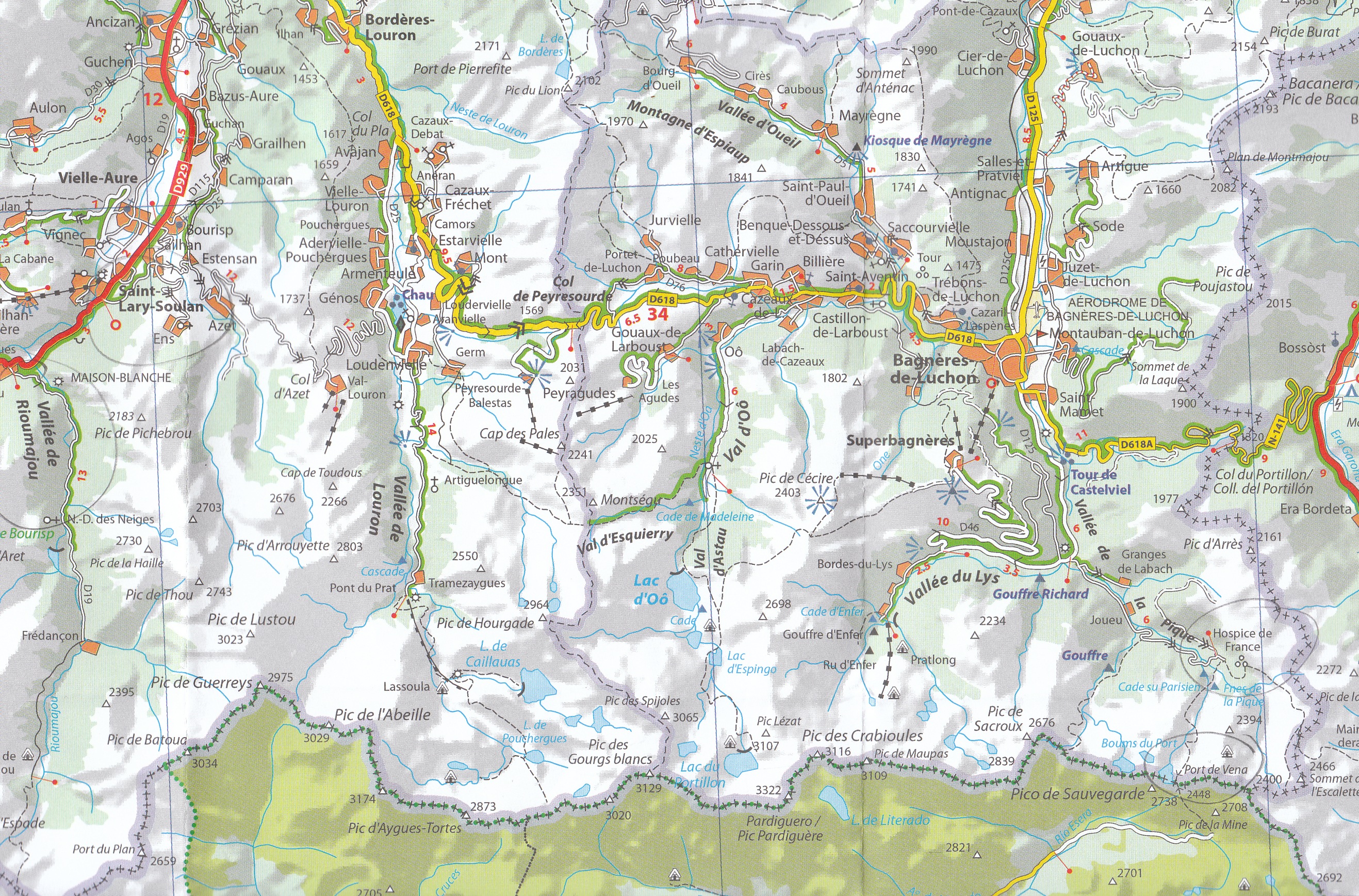
Where exactly was “La Cabane” located? The distance they initially cycled was 10 km, and they most likely stopped in or near the village of Saint-Bertrand-de-Comminges. I suspect that from there they continued cycling toward Bagnères-de-Luchon, which meant another 30 km by bicycle. From Montréjeau to Saint-Bertrand-de-Comminges there was only a 47-metre ascent; from there to Bagnères-de-Luchon the climb was 345 metres, which would have significantly reduced their pace. Then, from Bagnères-de-Luchon to the Hospice de France, there was a further ascent of 515 metres, this time over a distance of only 10 kilometres. It is therefore likely that “La Cabane” was, or still is, located near Bagnères-de-Luchon. From there, they continued on foot to cross the border.
On Tuesday, June 13th, the entire group set off toward the Spanish border, and after a three-day trek through the mountains, they crossed the frontier on Friday, June 16th 1944, near the Col de Rioumajou and the Hospice de France.
The guides remained with the group until they reached a shelter called “La Caverne,” about 45 kilometres from the Franco-Spanish border. From there, they were to continue by car to Barcelona. The car appeared on their second day in the shelter, but just outside Graus they were stopped and arrested by the Guardia Civil. All members of the group were imprisoned. This occurred on Tuesday, June 20st.
The following day, Wednesday, June 21st, they were transported under police escort via Huesca to Zaragoza, arriving there on Thursday, June 22nd. After his arrest, Danhaive gave a false name—Anthony Butler—and claimed to be Australian. When he left Belgium, he had been advised to do so if he encountered difficulties.
Danhaive remained in Zaragoza for about a week when the British authorities intervened on his behalf, and on Thursday, June 29th, he was permitted to travel on to Madrid. He took up residence at the Hotel Medicdia, where he met both the British chargé d’affaires, Chesswell, and the Belgian chargé d’affaires, M. Wodon.
On Monday, July 3rd 1944, Danhaive wrote a secret report in Madrid:
Transcription
RAPPORT SECRET No 300 of rapport No D75.
"A partir de l'hiver 41, 42 DANHAIVE cherche à rejoindre l'UK et dans ce but cherche des contacts. A partir de ce moment s'occuppé d'oeuvres patriotique et entre un rapport avec HENRI FREDERICQ qui se serai occupé d'une service en France. Ne trouve aucune ligne. Henri Fredericq partir de Juin 1943, tout en continuant ses études apporte sa collaboration à HENRI NEUMAN (CAESAR) 28 ans, docteur en droit à l'ULB. En Juin il fournit à Henri Neuman qui était recherche un gite chez les parent Danhaive en Basecles. Vers la fin de Juillet, sert d'intermédiare pour la compte de Henri Neuman afin de mettre en contact un groupe de résistance de Basecles (anciennement du Front Independance) avec le Groupe "G" de sabotage dont le Chef JEAN BURGERS aurait été arrêté vers Avril 1944 et dont Henri Neuman était Chef adjoint. Plus tard Danhaive met Groupe "G" de sabotage avec une carrière (région d' Ecausines) pour la fourniture de poudre noir. Fin Octobre 1943, s'occupe de réception d'armes par parachutage (opération finalement décommandée) et réalisée plus tard à Leuze (dorp ten noorden van Namen). Groupe "G" étant parti pour L' Angleterre, Danhaive ne le revoit que en février 1944, et en mars Groupe "G" lui fait demander s'il serait d'accord de partir en UK et subit un entrainement pour se faire parachute ensuite. Au debut d'avril Danhaive marque son accord, et reçoit instruction d'attendre. Prévenu le 23 avril 1944 par la femme dún agent de Henri Neuman que un certain JACQUES GUYOT qui devait partir comme recrue pour le service de renseignement le lendemain n'a pu être touché et qu'il peut partir à sa place. Il quitte Basecles le 24 avril 1944 et est à Bruxelles le 25 avril, avec le guide LUCIEN va jusque Paris via Mouscron, ou il arrive le 26 avril dans l'après midi (avec comme papiers un Reisbescheinigung fait à son nom, profession employé à Telefunken. Loge à Hotel de la Civette justqu'au 30 Avril, est conduit chez Madame DELORME à Rue Ernest Cresson 4, Paris 18e ou il reste 17 jours.
Le 13 mai 1944, est rejoint par un Hollandais J. DAUBRY (Biallosterski). Le 16 Mai quittent ensemble Paris, avec un guide et un plus GEORGE 'Le Commandant', pour Toulouse avec carte d'indentité françaiseet certificat de travail. Ils sont conduits chez un marchand de vélo. Le Chef local de la ligne qui se faisait appeler Q ou Monsieur EDOUARD vient chercher Danhaive et le Hollandais laissant la George 'Le Commandant'. Ils arrive à un autre gite et repartent le 22 mai 1944 pour Perpignant. Quittent Perpignant le 26 mai et rentrent suite à un accident survenu a George 'Le Commandant', leur dit-on à Toulouse chez Monsieur CABRIT, Rue de Rossignol 6. Repartent le 11 Juin de Toulouse rencontrent un Américan (Norman Pero) qui suit jusqu'a Montrejeau (cabane de bucherons, houthakkers) le 12 Avril 1944 rejoint par un Américan (Richard Elliot) et deux Belges, DRAPIER et SOUDAN. Dès lors le voyage est identique à la relation No. D76."
In the end, he (Danhaive), together with Drapier and Soudan and several Frenchmen, left Madrid on Wednesday, July 26th 1944. Under British protection, they travelled via San Roque to Gibraltar, and on Thursday, 27 July, Danhaive was put on a plane bound for England.
On August 22nd 1944, a report was drawn up in England in which Danhaive once again recounted his story. Below is an excerpt from it:
Transcription
" ... J'ai frenchi la frontière espagnole le 16 Juin 1944 et ai été arrêtte par la police le 20 Juin 1944 à Graus. ou j'ai été maintenu pendant une nuit; de là, j'ai été transféré a Huesca ou j'ai passé nuit également, puis, j'ai été achemine sur Saragosse ou j'ai vu le Consul de Grande Bretagne, qui m'a évité le séjour dans un camp de concentration espagnol. J'ai quitté Saragosse le 29 Juin 1944 pour Madrid; j'y suis arrivé le 30 Juin 1944. Parti de Madrid le 26 Juillet 1944 et j'ai atteint Gibraltar le 27 Juillet 1944 et j'ai quitté cette ville le 28 Juillet 1944. J'ai débargué à Bristol le 29 Juillet 1944 et j'ai été dirigé le même jour ..."
Jean Drapier’s account differs somewhat, as he travelled together with Soudan, but with different guides, via Paris to Spain. His report was also drawn up in Madrid on July 3rd; Drapier is designated D76. D76 is likewise mentioned in Danhaive’s report, who bears the designation D75 with serial number 300.
Transcription
RAPPORT SECRET (Ref. Déclar. No.76) No. 301)
"Jean DRAPIER rencontre le 24-1-1944, LOPPENS, Conseiller à la Court d'Appel qui lui signale que son nom figure sur une liste nominative de personnes demandées par le Gouvernement . Ayant marqué son accord, il se voit attribuer comme indicatif le nom de CAROLUS, puis ne reçoit plus signe de vie jusque vers le 20-5-1944, date à laquelle Loppens, lui confirme que l'on s'occupe du départ.
Le 5-5-1944 il est averti que le départ est fixé au 7-5-1944. Le 7 mai, est ..ris par Loppens en contact avec le guide THEO (Theo Janssen) et avec René SOUDAN. Ils partent pour Paris munis d'une fausse carte d'identité belge à leur propre nom et d'un passeport pour Paris. Arrivés à Paris vont loger dans un garage à Rue Caulyn Courentant 44 (Garage Coupel, Caulincourt 44, Parijs). Repartent le 8-5-1944 avec carte d'identité française (Nom de CHARDON). Sont conduits chez un boucher à RRE (??) ou ils séjournent dix jours. Dans ce gite rencontre Georges MARCQ qui depart seul le 16-5-1944. Eux même quittent le gite le 19-5-1944 pour Toulouse ou ils arrivent 20-5-1944 (pas de contrôle en chemin de fer). Sont hébergés chez un facteur des Postes jusqu'au 23-5-1944, dat à laquelle ils partent pour Carcassonne. N'ayant pas trouvé le guide (in Carcassonne) ils rentrent au gite (in Toulouse).
Depart le 24-5-1944, avec guide Espagnol pour Perpignan en chemin de fer jusque Quillan puis en autobus. Sont Hérbergé chez un Espagnol. Suite a un accident qui s'est produit la veille (Arrestation de deux Belges dont Georges MARCQ et un agent parachuté blessé (Ronald)), ils sont reconduite au gite de Toulouse ou était arrivé entretemps Josine MARDULYN (aka BETTY, or GENEVIEVE), dont le fréres est incarcéré à Saint Gilles depuis la fermeture de l'ULB.
Josine Mardulyn part le 27-5-1944 avec un compatriote magistrat, et il est convenu d'attendre le message radiodiffusé qui doit annoncer la bonne arrivée de ce groupe.
Le message "Chienne a eu quatre chiots" est entendu le 6-6-1944. Ils partent avec en plus un aviateur Américain (Richard Elliot) le 12 Juin pour Montrejeau. De là à pied jusque Saint Betrand-de-Comminges ou ils remis au guide passeur. Logent le 13 Juin dans une Cabane de berger ou ils rejoignent un Américain, le Belge (Danhaive) et un Hollandais (Biallosterski).
Le groupe campe le 14 Juin puis la nuit suivante en passant par un tunnel de captage arrivent à la frontière qu'ils passent le 16 Juin (probablement au Col de Venasque). Drapier étant épuisé de fatique, le groupe campe jusqu'a la nuit du 18 Juin en attendant une voiture que le guide est allé chercher.
Le 18 Juin, retrouvent la voiture que le près d'une centrale éléctrique (Route descendant à Graus). La voiture est arrêtée par la Garde Civile en amont de Graus, et amenée sous garde à Graus ou tout le groupe est arrêté.
Drapier déclare offcier aviateur Canadien né en 1905, rejoignant les Forces. Transféré a Basbastro puis Huesca le 21 Juin le groupe entre en contact avec le vice Consul de Grande Bretagne a Saragosse. Interrogé à nouveau Drapier se déclaré finalement civil Canadien.
Font une tentative de passage par Perpignant et rentrent à Toulouse qu'ils quittent finalement le 12 Juin pour l'Espagne via Montrejeau, St.Bertrand-de-Comminges. Entrent en Espagne le 16 Juin, sont arrêtés sur la route de Graus. Il se présente comme Canadien sous le nom de CHARDON. Transféré à Barbastro le 21 Juin, à Saragosse le 22 Juin et placé en résidence surveillée. Transféré à Madrid le 30 Juin 1944."
According to this report, the group was first detained by the Guardia Civil in Graus on 20 June. The following day, June 21st, they were transferred to Barbastro, and then a day later, on June 22nd, moved again to Zaragoza. According to Danhaive, the British Consul visited them there in a concentration camp. Did they remain in that camp for eight days before being allowed to travel to Madrid?
On Monday, April 24th 1944, Danhaive left his hometown of Basècles and travelled to Brussels. There he stayed with Mrs. Des Essarts at 29 Longue Rue aux Bois, Brussels. On Tuesday, April 25th, at around 5:00 p.m., his hostess took him to the Café Metropolian opposite the Gare du Midi station. There he met his guide, Lucien, and Lucien’s wife. He had already received false papers from a certain Miss Carette: an identity card and a so-called Reisebescheinigung in the name of Willy Michiels. The journey to Paris went via Kortrijk, Mouscron, and Tournai.
Upon arriving in Paris, Danhaive was taken by his guide Lucien to the “Hotel de la Civette,” where he remained until Sunday, April 30rd. This may have been a safe house located above a cigar shop (Civette). Each day he reported to Miss Bellières, a niece of Jacky Des Essarts, who lived near Porte de Neuilly. On Sunday, 30 April, he met Mrs. Germaine (a courier for JULIEN = Mitterrand). This grey-haired woman of about sixty took him to the house of the widow Odette Delorme at 4 Rue Ernest Cresson, Paris. Danhaive then stayed in this safe house for 17 days, until Tuesday, May 16th 1944.
On Saturday, May 13th, Tobias Biallosterski, alias Jan, also arrived at this address. A few days later, on Tuesday, May 16th, Germaine took both men to the Gare d’Austerlitz and introduced them to the guide who would accompany them to Toulouse. The guide had with him another man who also wished to escape to Spain: the Belgian Georges Marcq. At 10:30 a.m. on Wednesday, May 17th, the group arrived at Toulouse station. Danhaive had already received in Paris a false identity card in the name of Denizot, as well as a travel document from Germaine.
"Le 13 mai 1944, est rejoint par un Hollandais J. DAUBRY (Biallosterski). Le 16 Mai quittent ensemble Paris, avec un guide et un plus GEORGE 'Le Commandant', pour Toulouse avec carte d'indentité françaiseet certificat de travail." (Danhaive)
Upon arriving in the city, the three travelling companions were housed in a modest apartment above a bicycle shop. On Thursday, May 18th, Danhaive and Biallosterski were taken by a member of the Resistance to another safe house at 9 Rue du Mas St. Augustin in Toulouse. Georges Marcq remained behind alone in the apartment above the bicycle shop.
"Ils sont conduits chez un marchand de vélo. Le Chef local de la ligne qui se faisait appeler Q ou Monsieur EDOUARD vient chercher Danhaive et le Hollandais laissant la George 'Le Commandant'. Il arrive à un autre gite et repartent le 22 mai 1944 pour Perpignant." (Danhaive)
Both men remained there until Monday, May 22nd 1944. On that day, they departed for Perpignan. There, they stayed overnight with friends of their guide and, the following day, continued on to a village located only 7 km from the Franco-Spanish border. They remained there until Sunday, May 26th.
"Quittent Perpignant le 26 mai et rentrent suite à un accident survenu a George 'Le Commandant', leur dit-on à Toulouse chez Monsieur CABRIT, Rue de Rossignol 6." (Danhaive)
During this stay, they learned that Marcq, together with an agent (RONALD), two airmen, and two guides, had been arrested after leaving Perpignan. As a result, Danhaive and Biallosterski were forced to return to Toulouse, where they arrived again on Saturday, May 26th or Sunday, May 27th. Their guide accommodated them in the safe house of M. Cabrit, 6 Rue Rossignol, Toulouse. They remained there until Sunday, June 11th 1944.
On Sunday, June 11th, someone once again took them to the station and introduced them to a guide. He too had someone with him who wished to escape to Spain: the American airman Norman Pero. Together they travelled by train via Tarbes to Montréjeau (Gourdan-Polignan), where they arrived at 5:00 p.m. after many delays. There, they were met by a Spanish guide who had brought a bicycle for each of them, and they all set off toward the Pyrenees.
After cycling about ten kilometres, they halted and were given food and drink. At this point, another Spanish guide was waiting for them, Angele. At 10:00 p.m., after a strenuous journey, the group reached La Cabane. There they had to wait until a guide had fetched another group from Montréjeau. This group consisted of the Belgians Jean Drapier and René Soudan, and the American airman Richard Elliot.
"Repartent le 11 Juin de Toulouse rencontrent un Américan (Norman Pero) qui suit jusqu'a Montrejeau (cabane de bucherons, houthakkers) le 12 Avril 1944 rejoint par un Américan (Richard Elliot) et deux Belges, DRAPIER et SOUDAN." (Danhaive)
Where exactly was “La Cabane” located? The distance they initially cycled was 10 km, and they most likely stopped in or near the village of Saint-Bertrand-de-Comminges. I suspect that from there they continued cycling toward Bagnères-de-Luchon, which meant another 30 km by bicycle. From Montréjeau to Saint-Bertrand-de-Comminges there was only a 47-metre ascent; from there to Bagnères-de-Luchon the climb was 345 metres, which would have significantly reduced their pace. Then, from Bagnères-de-Luchon to the Hospice de France, there was a further ascent of 515 metres, this time over a distance of only 10 kilometres. It is therefore likely that “La Cabane” was, or still is, located near Bagnères-de-Luchon. From there, they continued on foot to cross the border.
On Tuesday, June 13th, the entire group set off toward the Spanish border, and after a three-day trek through the mountains, they crossed the frontier on Friday, June 16th 1944, near the Col de Rioumajou and the Hospice de France.
The guides remained with the group until they reached a shelter called “La Caverne,” about 45 kilometres from the Franco-Spanish border. From there, they were to continue by car to Barcelona. The car appeared on their second day in the shelter, but just outside Graus they were stopped and arrested by the Guardia Civil. All members of the group were imprisoned. This occurred on Tuesday, June 20st.
The following day, Wednesday, June 21st, they were transported under police escort via Huesca to Zaragoza, arriving there on Thursday, June 22nd. After his arrest, Danhaive gave a false name—Anthony Butler—and claimed to be Australian. When he left Belgium, he had been advised to do so if he encountered difficulties.
Danhaive remained in Zaragoza for about a week when the British authorities intervened on his behalf, and on Thursday, June 29th, he was permitted to travel on to Madrid. He took up residence at the Hotel Medicdia, where he met both the British chargé d’affaires, Chesswell, and the Belgian chargé d’affaires, M. Wodon.
On Monday, July 3rd 1944, Danhaive wrote a secret report in Madrid:
Transcription
RAPPORT SECRET No 300 of rapport No D75.
"A partir de l'hiver 41, 42 DANHAIVE cherche à rejoindre l'UK et dans ce but cherche des contacts. A partir de ce moment s'occuppé d'oeuvres patriotique et entre un rapport avec HENRI FREDERICQ qui se serai occupé d'une service en France. Ne trouve aucune ligne. Henri Fredericq partir de Juin 1943, tout en continuant ses études apporte sa collaboration à HENRI NEUMAN (CAESAR) 28 ans, docteur en droit à l'ULB. En Juin il fournit à Henri Neuman qui était recherche un gite chez les parent Danhaive en Basecles. Vers la fin de Juillet, sert d'intermédiare pour la compte de Henri Neuman afin de mettre en contact un groupe de résistance de Basecles (anciennement du Front Independance) avec le Groupe "G" de sabotage dont le Chef JEAN BURGERS aurait été arrêté vers Avril 1944 et dont Henri Neuman était Chef adjoint. Plus tard Danhaive met Groupe "G" de sabotage avec une carrière (région d' Ecausines) pour la fourniture de poudre noir. Fin Octobre 1943, s'occupe de réception d'armes par parachutage (opération finalement décommandée) et réalisée plus tard à Leuze (dorp ten noorden van Namen). Groupe "G" étant parti pour L' Angleterre, Danhaive ne le revoit que en février 1944, et en mars Groupe "G" lui fait demander s'il serait d'accord de partir en UK et subit un entrainement pour se faire parachute ensuite. Au debut d'avril Danhaive marque son accord, et reçoit instruction d'attendre. Prévenu le 23 avril 1944 par la femme dún agent de Henri Neuman que un certain JACQUES GUYOT qui devait partir comme recrue pour le service de renseignement le lendemain n'a pu être touché et qu'il peut partir à sa place. Il quitte Basecles le 24 avril 1944 et est à Bruxelles le 25 avril, avec le guide LUCIEN va jusque Paris via Mouscron, ou il arrive le 26 avril dans l'après midi (avec comme papiers un Reisbescheinigung fait à son nom, profession employé à Telefunken. Loge à Hotel de la Civette justqu'au 30 Avril, est conduit chez Madame DELORME à Rue Ernest Cresson 4, Paris 18e ou il reste 17 jours.
Le 13 mai 1944, est rejoint par un Hollandais J. DAUBRY (Biallosterski). Le 16 Mai quittent ensemble Paris, avec un guide et un plus GEORGE 'Le Commandant', pour Toulouse avec carte d'indentité françaiseet certificat de travail. Ils sont conduits chez un marchand de vélo. Le Chef local de la ligne qui se faisait appeler Q ou Monsieur EDOUARD vient chercher Danhaive et le Hollandais laissant la George 'Le Commandant'. Ils arrive à un autre gite et repartent le 22 mai 1944 pour Perpignant. Quittent Perpignant le 26 mai et rentrent suite à un accident survenu a George 'Le Commandant', leur dit-on à Toulouse chez Monsieur CABRIT, Rue de Rossignol 6. Repartent le 11 Juin de Toulouse rencontrent un Américan (Norman Pero) qui suit jusqu'a Montrejeau (cabane de bucherons, houthakkers) le 12 Avril 1944 rejoint par un Américan (Richard Elliot) et deux Belges, DRAPIER et SOUDAN. Dès lors le voyage est identique à la relation No. D76."
In the end, he (Danhaive), together with Drapier and Soudan and several Frenchmen, left Madrid on Wednesday, July 26th 1944. Under British protection, they travelled via San Roque to Gibraltar, and on Thursday, 27 July, Danhaive was put on a plane bound for England.
On August 22nd 1944, a report was drawn up in England in which Danhaive once again recounted his story. Below is an excerpt from it:
Transcription
" ... J'ai frenchi la frontière espagnole le 16 Juin 1944 et ai été arrêtte par la police le 20 Juin 1944 à Graus. ou j'ai été maintenu pendant une nuit; de là, j'ai été transféré a Huesca ou j'ai passé nuit également, puis, j'ai été achemine sur Saragosse ou j'ai vu le Consul de Grande Bretagne, qui m'a évité le séjour dans un camp de concentration espagnol. J'ai quitté Saragosse le 29 Juin 1944 pour Madrid; j'y suis arrivé le 30 Juin 1944. Parti de Madrid le 26 Juillet 1944 et j'ai atteint Gibraltar le 27 Juillet 1944 et j'ai quitté cette ville le 28 Juillet 1944. J'ai débargué à Bristol le 29 Juillet 1944 et j'ai été dirigé le même jour ..."
Jean Drapier’s account differs somewhat, as he travelled together with Soudan, but with different guides, via Paris to Spain. His report was also drawn up in Madrid on July 3rd; Drapier is designated D76. D76 is likewise mentioned in Danhaive’s report, who bears the designation D75 with serial number 300.
Transcription
RAPPORT SECRET (Ref. Déclar. No.76) No. 301)
"Jean DRAPIER rencontre le 24-1-1944, LOPPENS, Conseiller à la Court d'Appel qui lui signale que son nom figure sur une liste nominative de personnes demandées par le Gouvernement . Ayant marqué son accord, il se voit attribuer comme indicatif le nom de CAROLUS, puis ne reçoit plus signe de vie jusque vers le 20-5-1944, date à laquelle Loppens, lui confirme que l'on s'occupe du départ.
Le 5-5-1944 il est averti que le départ est fixé au 7-5-1944. Le 7 mai, est ..ris par Loppens en contact avec le guide THEO (Theo Janssen) et avec René SOUDAN. Ils partent pour Paris munis d'une fausse carte d'identité belge à leur propre nom et d'un passeport pour Paris. Arrivés à Paris vont loger dans un garage à Rue Caulyn Courentant 44 (Garage Coupel, Caulincourt 44, Parijs). Repartent le 8-5-1944 avec carte d'identité française (Nom de CHARDON). Sont conduits chez un boucher à RRE (??) ou ils séjournent dix jours. Dans ce gite rencontre Georges MARCQ qui depart seul le 16-5-1944. Eux même quittent le gite le 19-5-1944 pour Toulouse ou ils arrivent 20-5-1944 (pas de contrôle en chemin de fer). Sont hébergés chez un facteur des Postes jusqu'au 23-5-1944, dat à laquelle ils partent pour Carcassonne. N'ayant pas trouvé le guide (in Carcassonne) ils rentrent au gite (in Toulouse).
Depart le 24-5-1944, avec guide Espagnol pour Perpignan en chemin de fer jusque Quillan puis en autobus. Sont Hérbergé chez un Espagnol. Suite a un accident qui s'est produit la veille (Arrestation de deux Belges dont Georges MARCQ et un agent parachuté blessé (Ronald)), ils sont reconduite au gite de Toulouse ou était arrivé entretemps Josine MARDULYN (aka BETTY, or GENEVIEVE), dont le fréres est incarcéré à Saint Gilles depuis la fermeture de l'ULB.
Josine Mardulyn part le 27-5-1944 avec un compatriote magistrat, et il est convenu d'attendre le message radiodiffusé qui doit annoncer la bonne arrivée de ce groupe.
Le message "Chienne a eu quatre chiots" est entendu le 6-6-1944. Ils partent avec en plus un aviateur Américain (Richard Elliot) le 12 Juin pour Montrejeau. De là à pied jusque Saint Betrand-de-Comminges ou ils remis au guide passeur. Logent le 13 Juin dans une Cabane de berger ou ils rejoignent un Américain, le Belge (Danhaive) et un Hollandais (Biallosterski).
Le groupe campe le 14 Juin puis la nuit suivante en passant par un tunnel de captage arrivent à la frontière qu'ils passent le 16 Juin (probablement au Col de Venasque). Drapier étant épuisé de fatique, le groupe campe jusqu'a la nuit du 18 Juin en attendant une voiture que le guide est allé chercher.
Le 18 Juin, retrouvent la voiture que le près d'une centrale éléctrique (Route descendant à Graus). La voiture est arrêtée par la Garde Civile en amont de Graus, et amenée sous garde à Graus ou tout le groupe est arrêté.
Drapier déclare offcier aviateur Canadien né en 1905, rejoignant les Forces. Transféré a Basbastro puis Huesca le 21 Juin le groupe entre en contact avec le vice Consul de Grande Bretagne a Saragosse. Interrogé à nouveau Drapier se déclaré finalement civil Canadien.
Font une tentative de passage par Perpignant et rentrent à Toulouse qu'ils quittent finalement le 12 Juin pour l'Espagne via Montrejeau, St.Bertrand-de-Comminges. Entrent en Espagne le 16 Juin, sont arrêtés sur la route de Graus. Il se présente comme Canadien sous le nom de CHARDON. Transféré à Barbastro le 21 Juin, à Saragosse le 22 Juin et placé en résidence surveillée. Transféré à Madrid le 30 Juin 1944."
According to this report, the group was first detained by the Guardia Civil in Graus on 20 June. The following day, June 21st, they were transferred to Barbastro, and then a day later, on June 22nd, moved again to Zaragoza. According to Danhaive, the British Consul visited them there in a concentration camp. Did they remain in that camp for eight days before being allowed to travel to Madrid?
w.mugge@home.nl
WEGGUM.COM