
ABWEHR SECRET WIRELESS SERVICE.
The original shortwave connections from North America to Germany often suffered from poor east-west propagation conditions. Since radio communication in the north-south direction produced better results during corresponding tests, the radio stations in Mexico, Chile, and Argentina served as reporting centers and relay stations. For this reason, the Hamburg intelligence office established a large outstation with three transmitters and five receivers in Arcachon on the French Atlantic coast (Bay of Biscay), which was specifically used as a relay station for radio traffic with South America.
Other outstations of Hamburg-Wohldorf were located in Cavalla, Andernos, Cherbourg, Libourne/Dordogne, as well as in Esbjerg and Skagen.
From Hamburg, mobile intelligence operations in Denmark, Greece, Norway, and the Black Sea area were also directed by radio. Particularly noteworthy are the cutter and sailing yacht operations with the ships Kyloe, Passim, and Anni Braz Bihem in Spain, Ireland, South America, and South Africa. The first of these, Kyloe, was a 20-meter racing yacht that set sail from German-occupied France in the spring of 1941 to transport Robby Leibbrandt, a former policeman and heavyweight boxing champion, to his homeland of South Africa. There, he was to form resistance groups against the British and carry out acts of sabotage.
The 7,300-nautical-mile journey, under the command of Christian Nissen, who had participated in ocean regattas before the war, took 67 days. The return voyage covered another 5,400 nautical miles and ended in a harbor in Spanish Morocco, from where the crew returned to Germany by plane.
In the final days of the war, parts of the technical installations in Hamburg-Wohldorf, such as the existing radio equipment, were destroyed. Before that, a transmitting and receiving center had been built into a bus, intended to serve as a mobile backup station, first at Kyffhäuser and later with the planned destination of Schleswig-Holstein and Denmark. However, it was never put into operation.
In neutral countries, the KO Spain in Madrid, radio code name "Sabine" and the KO Portugal in Lisbon, radio code name "Lisa" operated an extensive radio and observation network with agents in England and North Africa. The line Madrid–Stahnsdorf (later Belzig) was one of those with the heaviest radio traffic and hourly transmission periods, mainly for harbor reports from Gibraltar received by the observation post in Algeciras. Other observation posts were located in Tangier and Tetouan, while sub-offices of KO Spain were set up in San Sebastian and Barcelona.
In the North African theater of war, there were several reconnaissance operations, the best-known being the deployment of two radio agents to Egypt (Operation “Salaam”). However, the stationing of the two agents in Cairo (Operation “Condor”) failed due to leadership errors and other circumstances, particularly the decryption of German intelligence radio messages within the British “Ultra” operation.
Radio communication by agents also proved its worth in 1942, when a Heinkel He 111 carrying an intelligence operations group had to make an emergency landing between Taiserbo and Kufra in the Libyan Desert, not far from the Egyptian border. The onboard radio equipment was damaged, but the portable radio set and the communications plan carried by the team survived the crash intact, allowing them to send a call for help.
Even during the occupation of Greece and Crete, connections could be established with the help of Afu (amateur radio) equipment that could not be achieved with Wehrmacht radio devices.
After the "Anschluss" of Austria, a large radio center was set up in the Vienna Woods near Breitenfurt for the newly created Abwehr Station XVII. During the later course of the war, this center, staffed with up to 3 officers, 51 non-commissioned officers, and 148 radio operators, managed, among other things, the radio networks for the Balkans and the Middle East. The Balkan network included the war organizations in Bulgaria/Sofia with branch offices in Varna, Burgas, Plovdiv, Svilengrad, and Kavala (each with its own radio network), as well as Turkey/Ankara with a reporting point in Istanbul.
For reconnaissance and sabotage purposes, an operation was launched through Afghanistan/Kabul with the goal of establishing bases in the Indian border region. This operation, codenamed Tiger, initially used radio links provided by the then, allied Italians in cooperation with the German Foreign Service. On September 8, 1942, a relay station called Tiger Castle (Tigerschloß) was temporarily put into operation in the occupied part of the Caucasus for this long-distance connection. A radio station in Kabul was to serve as a relay for the units deployed toward the Indian border. From Belzig, direct shortwave connections between Berlin and Kabul were later established, thanks to the improved capabilities of that main station.
Technically noteworthy is an operation in Iraq in 1941 that was jointly carried out by the Foreign Office, the Reich Ministry of Aviation, and Abwehr Sections I and II, together with Brandenburg personnel. For this purpose, so-called communications Ju 52 aircraft were brought along, planes of the proven long-range type, equipped with powerful built-in shortwave stations. With the help of such a ground-based relay station, continuous radio communication with Athens and Berlin was achieved starting May 17, 1941. From Baghdad, radio contact with Germany existed until May 1941, and from Shanghai in 1940, a very unstable connection. Only with the construction of the Belzig station and corresponding directional antennas were stable connections established from 1942 onward with the KO Far East.
From Shanghai, maritime reconnaissance in the Pacific was a special focus of the German Abwehr.
Like almost all Abwehr stations in the occupied territories, the Abwehr station in Oslo also had its own extensive radio network, as one example among many. In Norway, as in other occupied countries, the Abwehr organization could not rely on existing, secure, and sufficient wire networks, so radio communication had to be used. However, this led to the tragic failure of nearly all major Abwehr operations in the West, since the brilliant Ultra team of British radio intelligence and codebreaking in Bletchley Park was able, from December 1940 onward, to read the manually encrypted Abwehr messages and from the winter of 1941, also those encrypted with the Enigma machine.
The poor key security in the Abwehr’s radio network—and often also fatal carelessness, led to this success by England supported by experts from Poland and France, which was at that time completely unknown to the Abwehr. Interestingly, the equally top-secret radio communications of the political intelligence service of the RSHA/SD, with its radio centers in Berlin: Wannsee, Lichterfelde, and Friedenthal, withstood British decryption attempts. However, for foreign communications, the SD increasingly relied on the radio network of the Foreign Office.
Other outstations of Hamburg-Wohldorf were located in Cavalla, Andernos, Cherbourg, Libourne/Dordogne, as well as in Esbjerg and Skagen.
From Hamburg, mobile intelligence operations in Denmark, Greece, Norway, and the Black Sea area were also directed by radio. Particularly noteworthy are the cutter and sailing yacht operations with the ships Kyloe, Passim, and Anni Braz Bihem in Spain, Ireland, South America, and South Africa. The first of these, Kyloe, was a 20-meter racing yacht that set sail from German-occupied France in the spring of 1941 to transport Robby Leibbrandt, a former policeman and heavyweight boxing champion, to his homeland of South Africa. There, he was to form resistance groups against the British and carry out acts of sabotage.
The 7,300-nautical-mile journey, under the command of Christian Nissen, who had participated in ocean regattas before the war, took 67 days. The return voyage covered another 5,400 nautical miles and ended in a harbor in Spanish Morocco, from where the crew returned to Germany by plane.
In the final days of the war, parts of the technical installations in Hamburg-Wohldorf, such as the existing radio equipment, were destroyed. Before that, a transmitting and receiving center had been built into a bus, intended to serve as a mobile backup station, first at Kyffhäuser and later with the planned destination of Schleswig-Holstein and Denmark. However, it was never put into operation.
In neutral countries, the KO Spain in Madrid, radio code name "Sabine" and the KO Portugal in Lisbon, radio code name "Lisa" operated an extensive radio and observation network with agents in England and North Africa. The line Madrid–Stahnsdorf (later Belzig) was one of those with the heaviest radio traffic and hourly transmission periods, mainly for harbor reports from Gibraltar received by the observation post in Algeciras. Other observation posts were located in Tangier and Tetouan, while sub-offices of KO Spain were set up in San Sebastian and Barcelona.
In the North African theater of war, there were several reconnaissance operations, the best-known being the deployment of two radio agents to Egypt (Operation “Salaam”). However, the stationing of the two agents in Cairo (Operation “Condor”) failed due to leadership errors and other circumstances, particularly the decryption of German intelligence radio messages within the British “Ultra” operation.
Radio communication by agents also proved its worth in 1942, when a Heinkel He 111 carrying an intelligence operations group had to make an emergency landing between Taiserbo and Kufra in the Libyan Desert, not far from the Egyptian border. The onboard radio equipment was damaged, but the portable radio set and the communications plan carried by the team survived the crash intact, allowing them to send a call for help.
Even during the occupation of Greece and Crete, connections could be established with the help of Afu (amateur radio) equipment that could not be achieved with Wehrmacht radio devices.
After the "Anschluss" of Austria, a large radio center was set up in the Vienna Woods near Breitenfurt for the newly created Abwehr Station XVII. During the later course of the war, this center, staffed with up to 3 officers, 51 non-commissioned officers, and 148 radio operators, managed, among other things, the radio networks for the Balkans and the Middle East. The Balkan network included the war organizations in Bulgaria/Sofia with branch offices in Varna, Burgas, Plovdiv, Svilengrad, and Kavala (each with its own radio network), as well as Turkey/Ankara with a reporting point in Istanbul.
For reconnaissance and sabotage purposes, an operation was launched through Afghanistan/Kabul with the goal of establishing bases in the Indian border region. This operation, codenamed Tiger, initially used radio links provided by the then, allied Italians in cooperation with the German Foreign Service. On September 8, 1942, a relay station called Tiger Castle (Tigerschloß) was temporarily put into operation in the occupied part of the Caucasus for this long-distance connection. A radio station in Kabul was to serve as a relay for the units deployed toward the Indian border. From Belzig, direct shortwave connections between Berlin and Kabul were later established, thanks to the improved capabilities of that main station.
Technically noteworthy is an operation in Iraq in 1941 that was jointly carried out by the Foreign Office, the Reich Ministry of Aviation, and Abwehr Sections I and II, together with Brandenburg personnel. For this purpose, so-called communications Ju 52 aircraft were brought along, planes of the proven long-range type, equipped with powerful built-in shortwave stations. With the help of such a ground-based relay station, continuous radio communication with Athens and Berlin was achieved starting May 17, 1941. From Baghdad, radio contact with Germany existed until May 1941, and from Shanghai in 1940, a very unstable connection. Only with the construction of the Belzig station and corresponding directional antennas were stable connections established from 1942 onward with the KO Far East.
From Shanghai, maritime reconnaissance in the Pacific was a special focus of the German Abwehr.
Like almost all Abwehr stations in the occupied territories, the Abwehr station in Oslo also had its own extensive radio network, as one example among many. In Norway, as in other occupied countries, the Abwehr organization could not rely on existing, secure, and sufficient wire networks, so radio communication had to be used. However, this led to the tragic failure of nearly all major Abwehr operations in the West, since the brilliant Ultra team of British radio intelligence and codebreaking in Bletchley Park was able, from December 1940 onward, to read the manually encrypted Abwehr messages and from the winter of 1941, also those encrypted with the Enigma machine.
The poor key security in the Abwehr’s radio network—and often also fatal carelessness, led to this success by England supported by experts from Poland and France, which was at that time completely unknown to the Abwehr. Interestingly, the equally top-secret radio communications of the political intelligence service of the RSHA/SD, with its radio centers in Berlin: Wannsee, Lichterfelde, and Friedenthal, withstood British decryption attempts. However, for foreign communications, the SD increasingly relied on the radio network of the Foreign Office.








Communication with ships looking like fishingvessels for seaespionage and gathering weatherinformation.
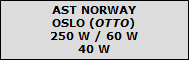













Equipped with Saram transmitter
for blind A2 transmissions.
for blind A2 transmissions.
South-England




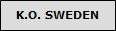

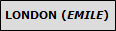
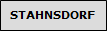

The most extensive Abwehr radio network connected the front reconnaissance units of the Abwehr with each other, with the major radio headquarters in Germany, and in part also with Abwehr stations in occupied territories or in the rear areas of the front. In the Abwehr command posts, Abwehr commands, and Abwehr squads — later renamed front reconnaissance command posts, front reconnaissance commands, and front reconnaissance squads — which were equipped with numerous subordinate radio reporting centers, was located the largest portion of the Abwehr’s radio personnel.
This large organization was almost constantly on the move, depending on whether operations were advancing or retreating, which led to the joking expression about the “Abwehr on wheels.” Only the supply of the Abwehr commands with appropriate vehicles was generally more than inadequate, as the Abwehr radio units were almost completely unsupplied by the supply depots of the Wehrmacht’s signal troops.
At the beginning of 1941, the Abwehr stations engaged in intelligence-gathering on the USSR, as well as the Ic sections of the armies and army groups involved in preparations for Operation Barbarossa, were instructed to intensify the use of agents against the Soviet Union. This also meant an expansion of the Secret Radio Reporting Service, and therefore, in a special action, all available radio amateurs with shortwave experience from the army, air force, navy, and other war-related organizations were transferred to the Abwehr and initially assembled in Stahnsdorf. The design office of the Abwehr’s own equipment production located there, which until then had mainly produced series of mains-powered shortwave devices in elegant leather cases according to Western travel standards, now began more intensively designing small and very small battery-powered radio sets.
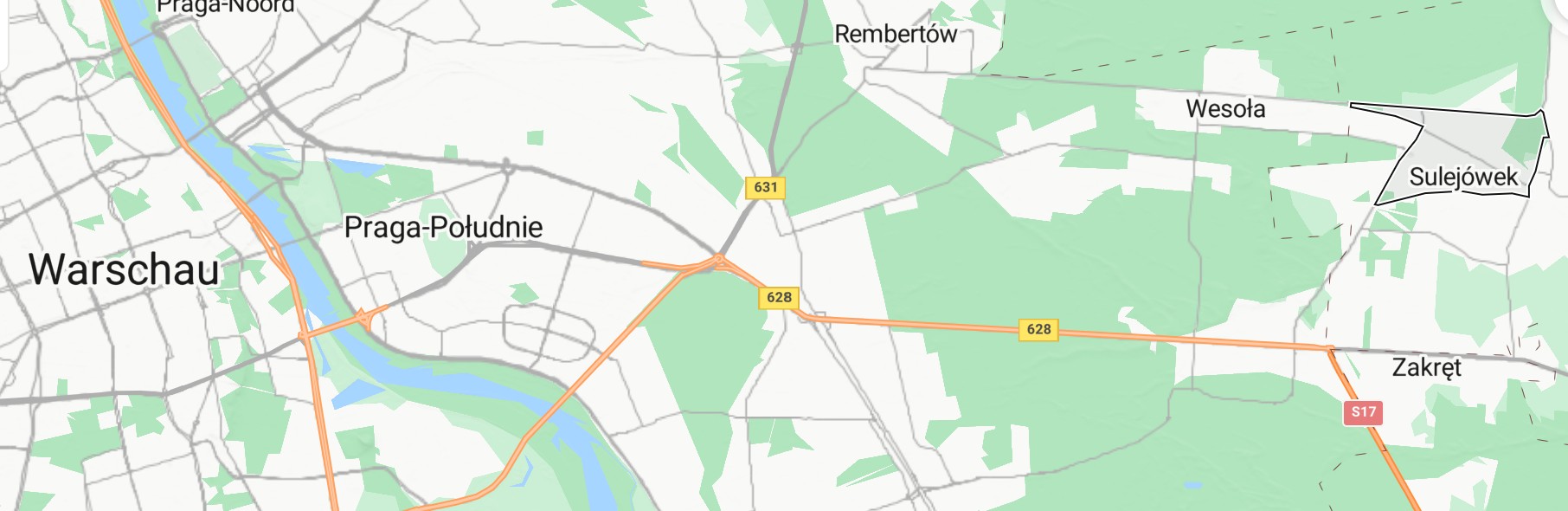
To ensure rapid communication between the Abwehr-I headquarters in Berlin and the front reconnaissance units of Section-I, an advanced command post under the code name Staff Walli-I was established on June 10, 1941, in Sulejówek near Warsaw. Major Hermann Baun, previously head of the Russia section of Abwehr-I, was appointed as the leader of Walli-I. Major Hermann Baun: born in 1897 in Odessa, grew up there, fluent in Russian and Ukrainian.
In early 1942, Abwehr-III also established a control center in Sulejówek, called Walli-III, for its Abwehr commands and squads, while the operations of the Abwehr-II units were largely directed from Brandenburg, and therefore Abwehr-II maintained only a branch office in Sulejówek.
On February 1, 1942, the head of Walli-III, Lieutenant Colonel Heinz Schmalschläger, as the highest-ranking officer, took overall command of the parts of the Walli Command Staff located in Sulejówek. Over the course of the Russian campaign, the role of this command staff shifted from the leadership of Abwehr front reconnaissance units toward their more logistical support as the Walli Supply Station.
Official designation from 1941 to 1944: Amt Ausland/Abwehr Office Walli-I, abbreviated Walli-I. Other names: Staff Walli-I, Command Staff Walli, Control Center-I-East, and later Front Reconnaissance Control Center-I-East.
For the Abwehr-I and Abwehr-III units, there was a joint, large radio headquarters in Sulejówek, which, after the fighting began, managed the communications between the Abwehr commands attached to the army groups and the Abwehr squads attached to the armies.
The deployment and control of informants and radio agents in the front areas fell under the responsibility of the Abwehr commands and squads, while parachute operations over longer distances were directed by Walli. Walli-I was also responsible for later reconnaissance in bandit and partisan areas in the army’s rear zones, the units assigned to this task were internally called Walli-I-Bd, Bd for Banden, meaning gangs or partisans.
Hermann Baun (born December 17, 1897 in Odessa, Russian Empire; † December 17, 1951, Germany) was a German Abwehr officer who coordinated espionage close to the front during the Wehrmacht's entire Russian campaign and was the first head of the Gehlen organization, the forerunner of Germany's Federal Intelligence Service (Bundesnachrichtendienst, BND).
Baun was born in Odessa as the son of the businessman Carl and Wilhelmine Baun. For his grammar school education he moved to Leipzig, where he received the general university entrance qualification on April 11, 1916. At the age of 18 he joined the German army, was trained as an infantry officer during the First World War and was promoted to lieutenant in the late summer of 1917. He joined missions on the western and eastern fronts and lastly was responsible for enemy reconnaissance as an intelligence officer in an army high command.
At the end of the war, Baun resigned from military service and returned to Odessa, Ukraine. There he married Irma Liebmann on February 5, 1920, and five years later had a son. From 1921 to 1929 Baun worked at the German Consulate in Odessa, where he first headed the welfare office for prisoners of war and civilian prisoners and became consulate secretary in mid-1922. He then served at the German embassy in Kiev, Ukraine, until 1937, where he last worked as an administrative assistant.
Subsequently, Baun returned to Germany and was employed in the Wehrmacht on July 1, 1937. After a six-month probationary period as a supplementary officer (E-Offizier), he was permanently employed on January 1, 1938 and promoted to captain. He was immediately transferred to the “Foreign / Defense Office Group” (Amtsgruppe Ausland/Abwehr), presumably because of his excellent Russian and Ukrainian language skills. There he worked in Department I (Abteilung I) (intelligence gathering) in Section I-H East / North (Referat I-H Ost/Nord), responsible for “land forces of eastern enemy states in the north” (Landstreitkräfte östlicher Feindstaaten im Norden). He evaluated open sources, Russian-language literature and press items.
In 1939 he was the person responsible for Poland and evaluated captured Polish intelligence documents. Around 1940 he was promoted to the rank of major and at the same time head of the Russia department within Department I. In June 1941, Baun moved to the vicinity of Warsaw to take over the management of the "Walli-I" department. It had the task of collecting intelligence close to the front, evaluating looted documents and questioning prisoners. All enemy intelligence about the Eastern Front came together there. The essential user of Walli I intelligence was the Foreign Army East department (Fremde Heere Ost, FHO). In 1943 Walli-I became part of the FHO, which Reinhard Gehlen had been leading since April 1942, and was subordinated to the department. An official assessment from 1943 shows Baun as the key figure in the secret intelligence service against Russia.
Baun's wife Irma and other family members were killed in the bomb attack on Dresden in 1945. On April 4, 1945, Baun and his adjutant Graber met with Gehlen and his deputy, Gerhard Wessel, in Bad Elster. They agreed to offer key personnel and materials to the Americans once the war was over. This meeting is also called the “Pact of Bad Elster” (Pakt von Bad Elster). They gave all the FHO members the code name “Fritz,” the Abwehr members “Otto.”
On July 29, 1945, the then Lieutenant Colonel Baun voluntarily handed himself to the Americans in Hinterberg near Sonthofen, in the South of Germany, and was held captive in the Allgäu area until September 1945. The Americans, who had specifically searched for Baun, hoped that he would render in-depth knowledge about the Soviet Union, the Red Army and contacts to intact agent networks. Gehlen and other FHO members (“Fritz”) were brought to the USA, where they were questioned extensively. The first preliminary questioning of Baun took place on August 16, 1945, in the interrogation center of the 3rd US Army in Freising, near Munich. On September 20, 1945, Gehlen and three associates were flown from the American Zone of Occupation in Germany to the U.S., to become spies for the U.S. Government. On October 10, 1945, Baun presented the Americans with a concept he had developed for an espionage and counter-espionage organization (code name: Keystone). In November 1945, Baun traveled through the American occupation zone to look for former Abwehr employees (“Otto”). They were accommodated in a small hotel in Oberursel, close to the US Military Intelligence Service Center im Camp King, Oberursel. On December 10, 1945, the US War Department issued a permit for espionage activities of the “Group Baun.” The brigadier general Edwin L. Sibert, G2 of the United States Forces European Theater, was directly responsible for the deployment of Baun. Sibert merged "Fritz" and "Otto members" together in the so-called Organization X.
According to Giles Scott-Smith :
In the summer of 1945 G-2 (US army intelligence) officer John Boker and his superior General Sibert tried to initiate “Operation X” to allow Gehlen’s group to reassemble and show what they could produce. When Gehlen and six others were suddenly flown to Washington for interrogation at US army intelligence headquarters, Sibert continued to gather other Gehlen associates and former Abwehr (German military intelligence) personnel at the US Detention and Interrogation Center in Oberursel. Operation X became Operation Rusty. Following Sibert’s departure in 1946, the G-2 apparatus maintained its hold over the Gehlen Organization via its liaison officers John Deane and Eric Waldman.
In early 1946, Baun’s focus was on counter-espionage in order to identify Soviet espionage in the American zone of occupation. Alfred Bentzinger was commissioned by Baun to set up “Agency 114” (Dienststelle 114) in Karlsruhe.
From April 1, 1946, the focus shifted to military reconnaissance in the Soviet occupation zone. This date was also the official starting signal for “Operation Rusty,” the effort of building up the nucleus for a future German secret service, whose first leader was Baun. In building up the organization, Baun (codename: “Berndt”) at first loosely incorporated former structures of the Wehrmacht's frontline reconnaissance against the Soviet Union, for which he had been responsible during World War II. He set up a staff under his leadership as well as several centrally organized departments. The staff was housed in a separate area within the U.S. Military Intelligence Service Center in Camp King, Oberursel. After August 1946, the Procurement Staff was transferred to a former hotel in Schmitten, 15 kilometers away (code name: Dustbin). For the staff personnel, Baun mainly relied on former members of the “Walli-I” Abwehr control center. The evaluation section of the staff, headed by Gustav-Adolf Tietze, analyzed the reports procured by the field organizations according to novelty value and credibility. The review was divided into four thematic areas: military, economic, political, and counter-espionage/anti-espionage.
By late summer 1946, he had 124 full-time employees. However, the reactivation of old agent networks of the Abwehr and Walli-I did not succeed. The main sources of information were interrogations of returning prisoners of war and refugees. Added to this was a modest telecommunications reconnaissance.
Gehlen returned from the US in July 1946 and was integrated into Operation Rusty. With him, an evaluation component was added to Operation Rusty, which he led.
Kevin Ruffner provides the following description of Operation Rusty in Eagle and Swastika: CIA and Nazi War Criminals and Collaborators :
In the summer of 1946, the Army returned Gen. Gehlen and the remaining FHO members to Germany. At this point, Lt. Col. John R. Deane, Jr., the operations officer at the Military Intelligence Service Center published his plans to merge Gehlen's BOLERO group with Baun's already existent staff, known as KEYSTONE. Gehlen would coordinate the functions of both elements of the German organization while he had direct responsibility for the Intelligence Group, which provided evaluations to economic, military, and political reports obtained by agents of Baun's Information Group.
The Army designated the entire organization Operation RUSTY, under the overall supervision of Col. Russell Philp, Lt. Col. John R. Deane, Jr., and Capt. Eric Waldman, who preceded Gehlen's return to Germany from Washington.
In February 1947, Gehlen took over the overall management of Operation Rusty, but Baun remained in charge of procurement until April 1947. The relationship between Gehlen and Baun visibly deteriorated, to a degree that Gehlen apparently even considered killing Baun. Der German Welt writes in that regard : "Why don't you kill Baun, if you can reconcile that with your conscience?" According to Gerhard Wessel's diary, Reinhard Gehlen said that to his confidant and deputy in March 1948. ... Because Gehlen desperately needed the former employees of Baun's control center to build up his "Gehlen Organization," he had to work with the charismatic but difficult officer. Baun, on the other hand, was quite willing to cooperate, "but had other ideas about a German intelligence service against the East," says military historian Rolf-Dieter Müller.
Baun was ultimately deposed by Gehlen and should henceforth deal with reconnaissance against the Soviet Union (deep reconnaissance / strategic reconnaissance). Activities were to be based in the Middle East, which is why Baun prepared for his departure to Tehran at the end of 1948. On January 31, 1950, he left the Gehlen organization. On December 17, 1951, Baun died on his 54th birthday due to cancer.
Source: FOIA Research.
Foreign Army East department (Fremde Heere Ost, FHO).
Chef: Oberst i.G. Reinhard Gehlen.
Second in command: Oberstleutnant i.G. Gerhard Wessel
Goup I.
Daily enemy sitituation report:
Chef: Major i.G. Karl-Heinrich Count von Rittberg.
Major i.G. Albert Schöller.
Major i.G. Fritz Scheibe.
Major i.G. Karl Otto von Czemicki.
Major i.G. Günther Romspeck.
Major i.G. Erich Freiherr Loeffelholz von Calberg.
Hauptmann Carl Ludwig Kesten.
Hauptmann Hermann Förster.
Hauptmann Jürgen Remé.
Oberleutnant Friedrich Wilhelm Arenhövel.
Hauptmann d.R. Ernst Günther Stegmann.
Oberleutnant Otto Polzer.
Oberleutnant Alexander von Mielecki.
Oberleutnant d.R. Walter Schüle.
Oberleutnant d.R. Herbert Bauer.
Oberleutnant Hans Erdmann-Schönbeck.
Oberleutnant d.R. Hellmut von Hogens.
Leutnant d.R. Ulrich Jönel.
Group II.
Total situation Sovjet-Russia:
Chef: Major i.G. Horst Hienbenz.
Major i.G. Joachim Völkel.
Major i.G. Hans Hinrichs.
Hauptmann d.R. Kurt Gollnitz.
Hauptmann d.R. Joachim Bausch.
Hautmann d.R. Otto Erhardt.
Hauptmann d.R. Wolfgang Dix.
Oberleutnant Peter von Vörnewyck.
Oberleutnant Theodor Pelizoeus.
Oberleutnant d.R. Günter Letschert.
Oberleutnant d.R. Adolf Heinrich von Armin.
Group III.
Interrogation & loot analysis:
Chef: Oberstleutnant Hellmut Nouck.
Hauptmann d.R. Georg Pock.
Hauptman d.R. Edward Schabert.
Oberleutnant d.R. Elfried Eckert.
Oberleutnant d.R. Johannes Hoheisel.
Sonderführer Elmer Arre.
Sonderführer Emanuel Haller.
Sonderführer Georg Elster.
Sonderführer Waldemar Hindersin.
Sonderführer Georg von Rauch.
Group IV.
Scandinavia:
Chef: Oberstleutnant Karl Ogilvie.
Leutnant d.R. Count von Merveldt.
Leutnant d.R. Adolf Voss.
Group V.
Number station:
Chef: Oberinspektor Wogner.
Group VI.
Commander staffquarters:
Chef: Major d.R. Victor von der Marwitz.
Interrogation camp:
Chef: Hauptmann d.R. Kurt Ruhtenberg.
Oberleutnant d.R. Bernhard Blossfeldt.
Oberleutnant d.R. Axel von Melville.
This large organization was almost constantly on the move, depending on whether operations were advancing or retreating, which led to the joking expression about the “Abwehr on wheels.” Only the supply of the Abwehr commands with appropriate vehicles was generally more than inadequate, as the Abwehr radio units were almost completely unsupplied by the supply depots of the Wehrmacht’s signal troops.
At the beginning of 1941, the Abwehr stations engaged in intelligence-gathering on the USSR, as well as the Ic sections of the armies and army groups involved in preparations for Operation Barbarossa, were instructed to intensify the use of agents against the Soviet Union. This also meant an expansion of the Secret Radio Reporting Service, and therefore, in a special action, all available radio amateurs with shortwave experience from the army, air force, navy, and other war-related organizations were transferred to the Abwehr and initially assembled in Stahnsdorf. The design office of the Abwehr’s own equipment production located there, which until then had mainly produced series of mains-powered shortwave devices in elegant leather cases according to Western travel standards, now began more intensively designing small and very small battery-powered radio sets.
To ensure rapid communication between the Abwehr-I headquarters in Berlin and the front reconnaissance units of Section-I, an advanced command post under the code name Staff Walli-I was established on June 10, 1941, in Sulejówek near Warsaw. Major Hermann Baun, previously head of the Russia section of Abwehr-I, was appointed as the leader of Walli-I. Major Hermann Baun: born in 1897 in Odessa, grew up there, fluent in Russian and Ukrainian.
In early 1942, Abwehr-III also established a control center in Sulejówek, called Walli-III, for its Abwehr commands and squads, while the operations of the Abwehr-II units were largely directed from Brandenburg, and therefore Abwehr-II maintained only a branch office in Sulejówek.
On February 1, 1942, the head of Walli-III, Lieutenant Colonel Heinz Schmalschläger, as the highest-ranking officer, took overall command of the parts of the Walli Command Staff located in Sulejówek. Over the course of the Russian campaign, the role of this command staff shifted from the leadership of Abwehr front reconnaissance units toward their more logistical support as the Walli Supply Station.
Official designation from 1941 to 1944: Amt Ausland/Abwehr Office Walli-I, abbreviated Walli-I. Other names: Staff Walli-I, Command Staff Walli, Control Center-I-East, and later Front Reconnaissance Control Center-I-East.
For the Abwehr-I and Abwehr-III units, there was a joint, large radio headquarters in Sulejówek, which, after the fighting began, managed the communications between the Abwehr commands attached to the army groups and the Abwehr squads attached to the armies.
The deployment and control of informants and radio agents in the front areas fell under the responsibility of the Abwehr commands and squads, while parachute operations over longer distances were directed by Walli. Walli-I was also responsible for later reconnaissance in bandit and partisan areas in the army’s rear zones, the units assigned to this task were internally called Walli-I-Bd, Bd for Banden, meaning gangs or partisans.
Hermann Baun (born December 17, 1897 in Odessa, Russian Empire; † December 17, 1951, Germany) was a German Abwehr officer who coordinated espionage close to the front during the Wehrmacht's entire Russian campaign and was the first head of the Gehlen organization, the forerunner of Germany's Federal Intelligence Service (Bundesnachrichtendienst, BND).
Baun was born in Odessa as the son of the businessman Carl and Wilhelmine Baun. For his grammar school education he moved to Leipzig, where he received the general university entrance qualification on April 11, 1916. At the age of 18 he joined the German army, was trained as an infantry officer during the First World War and was promoted to lieutenant in the late summer of 1917. He joined missions on the western and eastern fronts and lastly was responsible for enemy reconnaissance as an intelligence officer in an army high command.
At the end of the war, Baun resigned from military service and returned to Odessa, Ukraine. There he married Irma Liebmann on February 5, 1920, and five years later had a son. From 1921 to 1929 Baun worked at the German Consulate in Odessa, where he first headed the welfare office for prisoners of war and civilian prisoners and became consulate secretary in mid-1922. He then served at the German embassy in Kiev, Ukraine, until 1937, where he last worked as an administrative assistant.
Subsequently, Baun returned to Germany and was employed in the Wehrmacht on July 1, 1937. After a six-month probationary period as a supplementary officer (E-Offizier), he was permanently employed on January 1, 1938 and promoted to captain. He was immediately transferred to the “Foreign / Defense Office Group” (Amtsgruppe Ausland/Abwehr), presumably because of his excellent Russian and Ukrainian language skills. There he worked in Department I (Abteilung I) (intelligence gathering) in Section I-H East / North (Referat I-H Ost/Nord), responsible for “land forces of eastern enemy states in the north” (Landstreitkräfte östlicher Feindstaaten im Norden). He evaluated open sources, Russian-language literature and press items.
In 1939 he was the person responsible for Poland and evaluated captured Polish intelligence documents. Around 1940 he was promoted to the rank of major and at the same time head of the Russia department within Department I. In June 1941, Baun moved to the vicinity of Warsaw to take over the management of the "Walli-I" department. It had the task of collecting intelligence close to the front, evaluating looted documents and questioning prisoners. All enemy intelligence about the Eastern Front came together there. The essential user of Walli I intelligence was the Foreign Army East department (Fremde Heere Ost, FHO). In 1943 Walli-I became part of the FHO, which Reinhard Gehlen had been leading since April 1942, and was subordinated to the department. An official assessment from 1943 shows Baun as the key figure in the secret intelligence service against Russia.
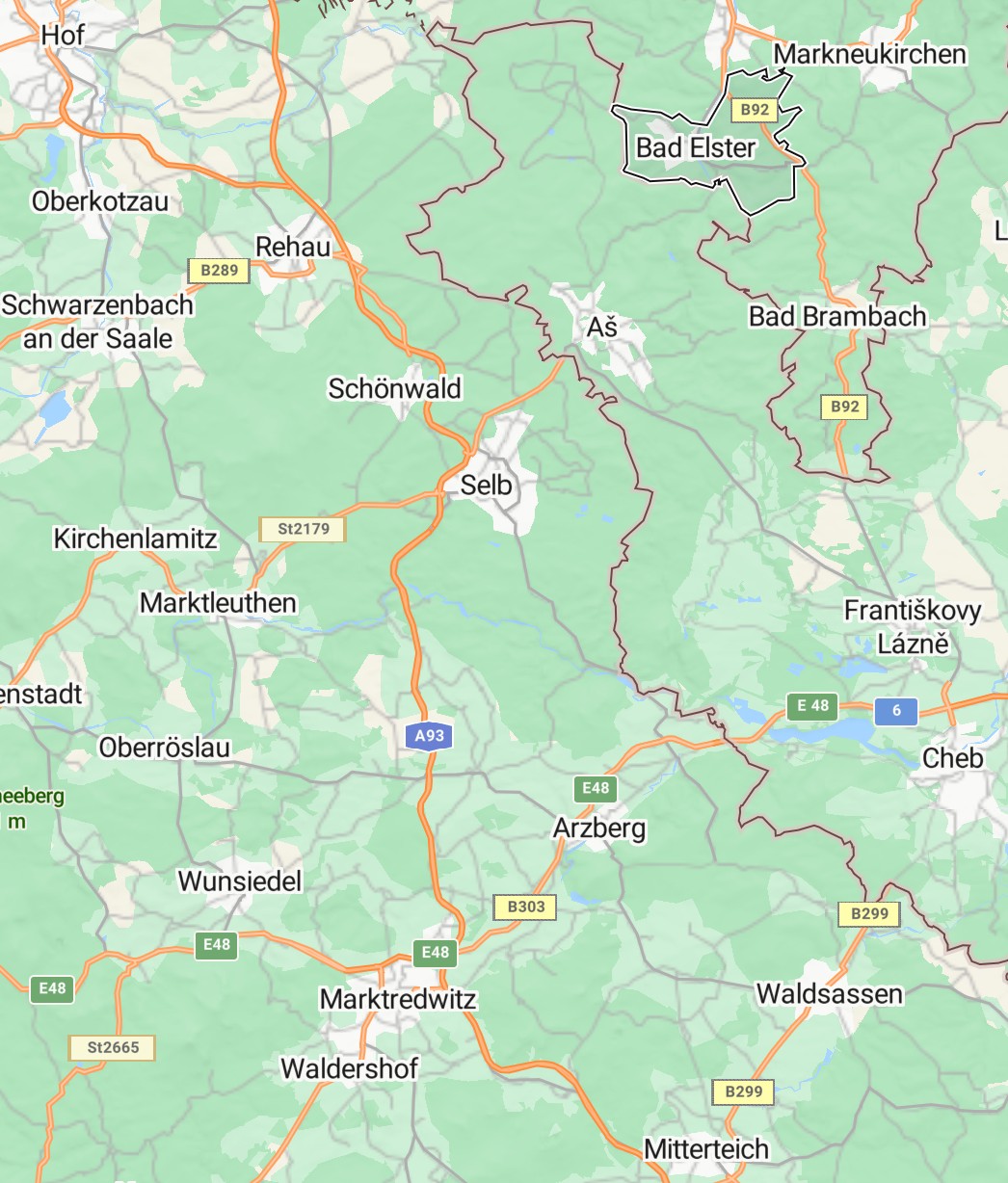
Baun's wife Irma and other family members were killed in the bomb attack on Dresden in 1945. On April 4, 1945, Baun and his adjutant Graber met with Gehlen and his deputy, Gerhard Wessel, in Bad Elster. They agreed to offer key personnel and materials to the Americans once the war was over. This meeting is also called the “Pact of Bad Elster” (Pakt von Bad Elster). They gave all the FHO members the code name “Fritz,” the Abwehr members “Otto.”
On July 29, 1945, the then Lieutenant Colonel Baun voluntarily handed himself to the Americans in Hinterberg near Sonthofen, in the South of Germany, and was held captive in the Allgäu area until September 1945. The Americans, who had specifically searched for Baun, hoped that he would render in-depth knowledge about the Soviet Union, the Red Army and contacts to intact agent networks. Gehlen and other FHO members (“Fritz”) were brought to the USA, where they were questioned extensively. The first preliminary questioning of Baun took place on August 16, 1945, in the interrogation center of the 3rd US Army in Freising, near Munich. On September 20, 1945, Gehlen and three associates were flown from the American Zone of Occupation in Germany to the U.S., to become spies for the U.S. Government. On October 10, 1945, Baun presented the Americans with a concept he had developed for an espionage and counter-espionage organization (code name: Keystone). In November 1945, Baun traveled through the American occupation zone to look for former Abwehr employees (“Otto”). They were accommodated in a small hotel in Oberursel, close to the US Military Intelligence Service Center im Camp King, Oberursel. On December 10, 1945, the US War Department issued a permit for espionage activities of the “Group Baun.” The brigadier general Edwin L. Sibert, G2 of the United States Forces European Theater, was directly responsible for the deployment of Baun. Sibert merged "Fritz" and "Otto members" together in the so-called Organization X.
According to Giles Scott-Smith :
In the summer of 1945 G-2 (US army intelligence) officer John Boker and his superior General Sibert tried to initiate “Operation X” to allow Gehlen’s group to reassemble and show what they could produce. When Gehlen and six others were suddenly flown to Washington for interrogation at US army intelligence headquarters, Sibert continued to gather other Gehlen associates and former Abwehr (German military intelligence) personnel at the US Detention and Interrogation Center in Oberursel. Operation X became Operation Rusty. Following Sibert’s departure in 1946, the G-2 apparatus maintained its hold over the Gehlen Organization via its liaison officers John Deane and Eric Waldman.
In early 1946, Baun’s focus was on counter-espionage in order to identify Soviet espionage in the American zone of occupation. Alfred Bentzinger was commissioned by Baun to set up “Agency 114” (Dienststelle 114) in Karlsruhe.
From April 1, 1946, the focus shifted to military reconnaissance in the Soviet occupation zone. This date was also the official starting signal for “Operation Rusty,” the effort of building up the nucleus for a future German secret service, whose first leader was Baun. In building up the organization, Baun (codename: “Berndt”) at first loosely incorporated former structures of the Wehrmacht's frontline reconnaissance against the Soviet Union, for which he had been responsible during World War II. He set up a staff under his leadership as well as several centrally organized departments. The staff was housed in a separate area within the U.S. Military Intelligence Service Center in Camp King, Oberursel. After August 1946, the Procurement Staff was transferred to a former hotel in Schmitten, 15 kilometers away (code name: Dustbin). For the staff personnel, Baun mainly relied on former members of the “Walli-I” Abwehr control center. The evaluation section of the staff, headed by Gustav-Adolf Tietze, analyzed the reports procured by the field organizations according to novelty value and credibility. The review was divided into four thematic areas: military, economic, political, and counter-espionage/anti-espionage.
By late summer 1946, he had 124 full-time employees. However, the reactivation of old agent networks of the Abwehr and Walli-I did not succeed. The main sources of information were interrogations of returning prisoners of war and refugees. Added to this was a modest telecommunications reconnaissance.
Gehlen returned from the US in July 1946 and was integrated into Operation Rusty. With him, an evaluation component was added to Operation Rusty, which he led.
Kevin Ruffner provides the following description of Operation Rusty in Eagle and Swastika: CIA and Nazi War Criminals and Collaborators :
In the summer of 1946, the Army returned Gen. Gehlen and the remaining FHO members to Germany. At this point, Lt. Col. John R. Deane, Jr., the operations officer at the Military Intelligence Service Center published his plans to merge Gehlen's BOLERO group with Baun's already existent staff, known as KEYSTONE. Gehlen would coordinate the functions of both elements of the German organization while he had direct responsibility for the Intelligence Group, which provided evaluations to economic, military, and political reports obtained by agents of Baun's Information Group.
The Army designated the entire organization Operation RUSTY, under the overall supervision of Col. Russell Philp, Lt. Col. John R. Deane, Jr., and Capt. Eric Waldman, who preceded Gehlen's return to Germany from Washington.
In February 1947, Gehlen took over the overall management of Operation Rusty, but Baun remained in charge of procurement until April 1947. The relationship between Gehlen and Baun visibly deteriorated, to a degree that Gehlen apparently even considered killing Baun. Der German Welt writes in that regard : "Why don't you kill Baun, if you can reconcile that with your conscience?" According to Gerhard Wessel's diary, Reinhard Gehlen said that to his confidant and deputy in March 1948. ... Because Gehlen desperately needed the former employees of Baun's control center to build up his "Gehlen Organization," he had to work with the charismatic but difficult officer. Baun, on the other hand, was quite willing to cooperate, "but had other ideas about a German intelligence service against the East," says military historian Rolf-Dieter Müller.
Baun was ultimately deposed by Gehlen and should henceforth deal with reconnaissance against the Soviet Union (deep reconnaissance / strategic reconnaissance). Activities were to be based in the Middle East, which is why Baun prepared for his departure to Tehran at the end of 1948. On January 31, 1950, he left the Gehlen organization. On December 17, 1951, Baun died on his 54th birthday due to cancer.
Source: FOIA Research.
Foreign Army East department (Fremde Heere Ost, FHO).
Chef: Oberst i.G. Reinhard Gehlen.
Second in command: Oberstleutnant i.G. Gerhard Wessel
Goup I.
Daily enemy sitituation report:
Chef: Major i.G. Karl-Heinrich Count von Rittberg.
Major i.G. Albert Schöller.
Major i.G. Fritz Scheibe.
Major i.G. Karl Otto von Czemicki.
Major i.G. Günther Romspeck.
Major i.G. Erich Freiherr Loeffelholz von Calberg.
Hauptmann Carl Ludwig Kesten.
Hauptmann Hermann Förster.
Hauptmann Jürgen Remé.
Oberleutnant Friedrich Wilhelm Arenhövel.
Hauptmann d.R. Ernst Günther Stegmann.
Oberleutnant Otto Polzer.
Oberleutnant Alexander von Mielecki.
Oberleutnant d.R. Walter Schüle.
Oberleutnant d.R. Herbert Bauer.
Oberleutnant Hans Erdmann-Schönbeck.
Oberleutnant d.R. Hellmut von Hogens.
Leutnant d.R. Ulrich Jönel.
Group II.
Total situation Sovjet-Russia:
Chef: Major i.G. Horst Hienbenz.
Major i.G. Joachim Völkel.
Major i.G. Hans Hinrichs.
Hauptmann d.R. Kurt Gollnitz.
Hauptmann d.R. Joachim Bausch.
Hautmann d.R. Otto Erhardt.
Hauptmann d.R. Wolfgang Dix.
Oberleutnant Peter von Vörnewyck.
Oberleutnant Theodor Pelizoeus.
Oberleutnant d.R. Günter Letschert.
Oberleutnant d.R. Adolf Heinrich von Armin.
Group III.
Interrogation & loot analysis:
Chef: Oberstleutnant Hellmut Nouck.
Hauptmann d.R. Georg Pock.
Hauptman d.R. Edward Schabert.
Oberleutnant d.R. Elfried Eckert.
Oberleutnant d.R. Johannes Hoheisel.
Sonderführer Elmer Arre.
Sonderführer Emanuel Haller.
Sonderführer Georg Elster.
Sonderführer Waldemar Hindersin.
Sonderführer Georg von Rauch.
Group IV.
Scandinavia:
Chef: Oberstleutnant Karl Ogilvie.
Leutnant d.R. Count von Merveldt.
Leutnant d.R. Adolf Voss.
Group V.
Number station:
Chef: Oberinspektor Wogner.
Group VI.
Commander staffquarters:
Chef: Major d.R. Victor von der Marwitz.
Interrogation camp:
Chef: Hauptmann d.R. Kurt Ruhtenberg.
Oberleutnant d.R. Bernhard Blossfeldt.
Oberleutnant d.R. Axel von Melville.



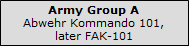
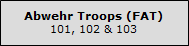
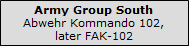
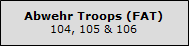
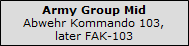
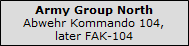
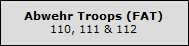
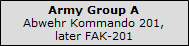
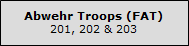
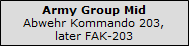
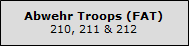
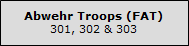
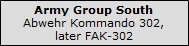
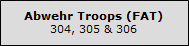
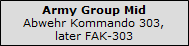
Organisation of the front reconnaissance troops during the first phase of the war in the east 01-06-1942.



































Angerburg


Rastenburg







Nikolaiken

Angerburg
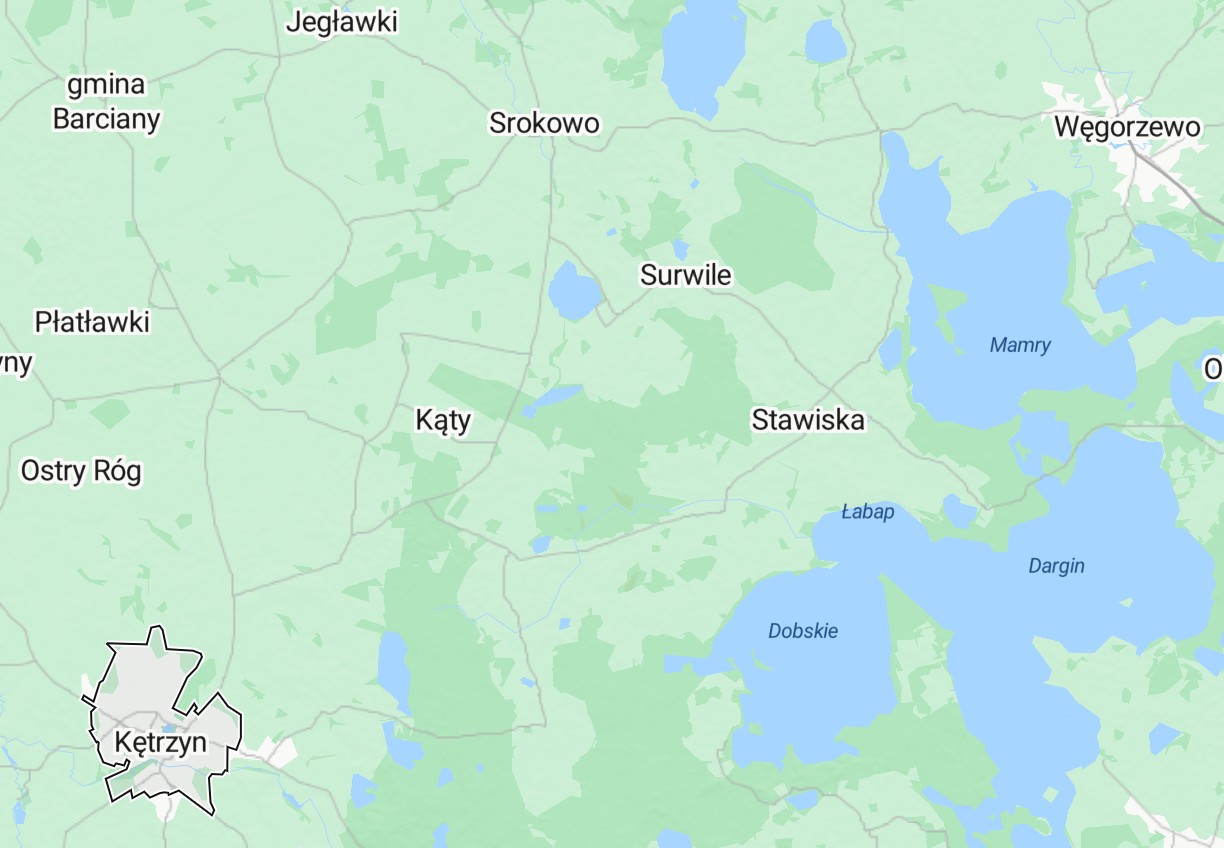
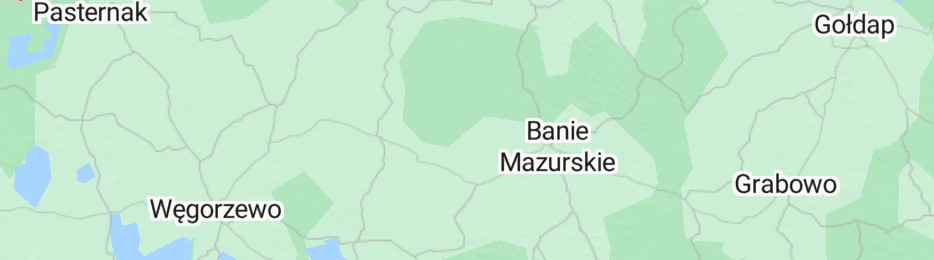
With the relocation of the Führer Headquarters (FHQ) Wolf’s Lair near Rastenburg on 23 June 1941, and the transfer of the operational sections of the Wehrmacht High Commands to the surrounding area—the OKL to a property near Goldap known as Robinson, and the OKH to a similar installation near Angerburg with the cover name Mauerwald, about 50 km northeast of Rastenburg—the General Staff department Foreign Armies East (FHO) pressed for the Abwehr, as one of its main suppliers of information, to work as close to the FHQ as possible.
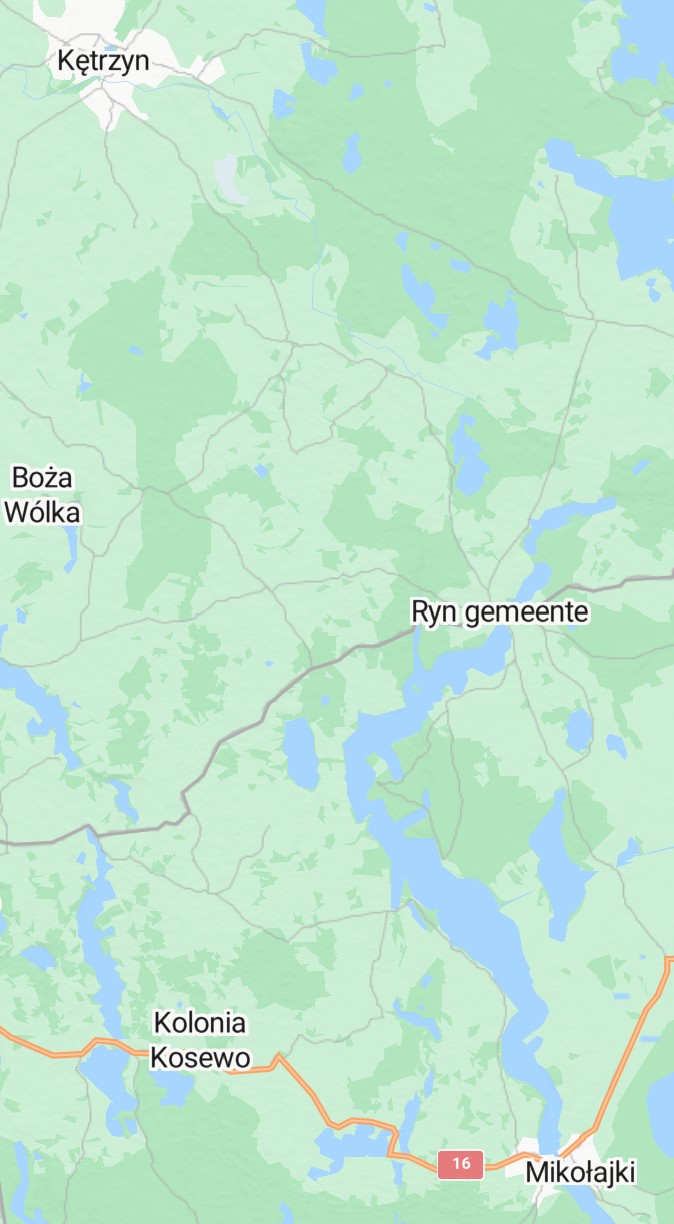
After Reinhard Gehlen took over leadership of Foreign Armies East in April 1942, and, in coordination with Canaris, was also given operational command of Walli I and III, he brought Baun and most of the Front Intelligence Control Center I-East to Nikolaiken, where they occupied the former spa hotel. The rest remained in Sulejowek as the Walli-I Command Staff, as did Walli-III.
The radio center Atlas of Front Intelligence Control Center I-East had been set up in a park behind the spa hotel. There were several well-camouflaged barracks there, housing interpreters, NCOs and enlisted men, as well as the remotely keyed short-wave transmitters. For the radio personnel at the receiving stations with equipment for remote keying of the transmitters, there was a larger barrack between Uferstraße and the lakeshore.
In July 1942, the Führer Headquarters and the associated operational staff units moved from the Wolf’s Lair to Werwolf near Vinnytsia (Vinnytsja) in Ukraine, about 230 km southwest of Kyiv. The Abwehr took up quarters in the palace, Woronowytsia Castle in the town of the same name (Voronovytsja) Southeast of Vinnytsia, which had previously served as a school. The radio center Atlas remained in Nikolaiken, as they did not want to jeopardize the existing and stable radio connections from there. The same applied to the radio center of Walli-III in Sulejówek, both radio centers, just like Woronowiza Castle, were connected to the command network of the Führer Headquarters (FHQ) and had corresponding telephone, teleprinter, and cipher-writer connections (T-52e cipher teleprinter). For this reason, only a small radio station, code name Irene, was set up in Woronowiza as a reserve and for individual rapid connections.
Because Woronowiza Castle served not only as the field headquarters for Admiral Canaris but was also used by the Foreign Affairs Department (Rear Admiral Bürkner) to host foreign military attachés accredited to the Führer Headquarters, parts of it had been extensively restored and furnished.
In the main building and the adjoining left wing were the accommodations of Admiral Canaris, Rear Admiral Bürkner, and other high-ranking guests; on the upper floor, among other things, the wire-communication center and the Irene radio station were located.
After the relocation of the FHQ back to the Wolf’s Lair and with no prospect of returning to Vinnytsia in the subsequent period (Stalingrad, loss of the Caucasus front, etc.), the Front Intelligence Control Center I-East also moved back to Nikolaiken.
Woronowiza Castle then served as a short-term interim quarters for higher Abwehr officers during front-line visits and, during the retreat, for a somewhat longer period for the Front Intelligence Command 102, Lieutenant Colonel Lienhard, as well as for the Abwehr special detachment Dromedar of the Armenian freedom movement, General Drastamat Kanayan, called Dro, his chief of staff Colonel Tigris Bagdasarian, and the German detachment commander Rittmeister Puluj.
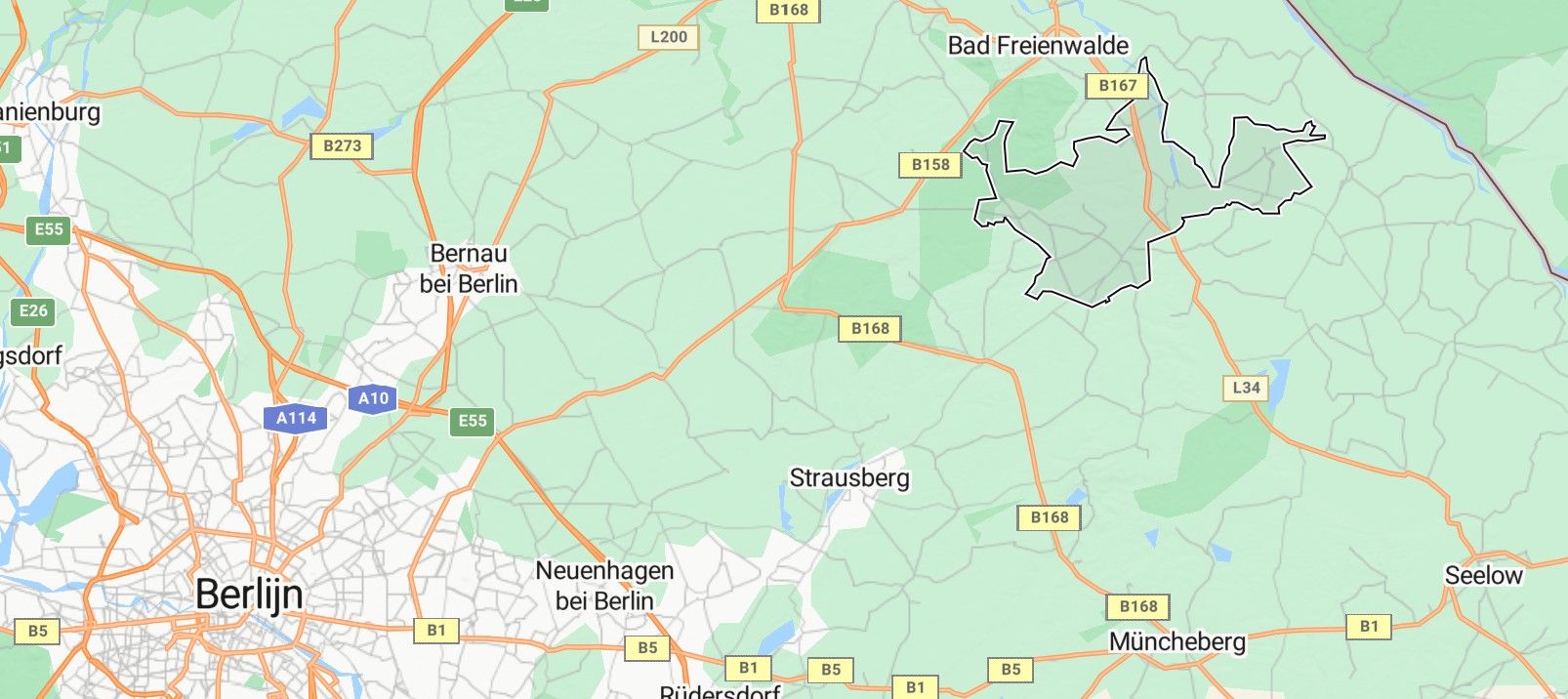
Due to the further course of the war, the Front Intelligence Control Center I-East relocated its radio center in the summer of 1944 from Nikolaiken to Harnekop Castle near Wriezen, in early 1945 to Bad Elster, and toward the end of the war to southern Germany in the Allgäu.
After Reinhard Gehlen took over leadership of Foreign Armies East in April 1942, and, in coordination with Canaris, was also given operational command of Walli I and III, he brought Baun and most of the Front Intelligence Control Center I-East to Nikolaiken, where they occupied the former spa hotel. The rest remained in Sulejowek as the Walli-I Command Staff, as did Walli-III.
The radio center Atlas of Front Intelligence Control Center I-East had been set up in a park behind the spa hotel. There were several well-camouflaged barracks there, housing interpreters, NCOs and enlisted men, as well as the remotely keyed short-wave transmitters. For the radio personnel at the receiving stations with equipment for remote keying of the transmitters, there was a larger barrack between Uferstraße and the lakeshore.
In July 1942, the Führer Headquarters and the associated operational staff units moved from the Wolf’s Lair to Werwolf near Vinnytsia (Vinnytsja) in Ukraine, about 230 km southwest of Kyiv. The Abwehr took up quarters in the palace, Woronowytsia Castle in the town of the same name (Voronovytsja) Southeast of Vinnytsia, which had previously served as a school. The radio center Atlas remained in Nikolaiken, as they did not want to jeopardize the existing and stable radio connections from there. The same applied to the radio center of Walli-III in Sulejówek, both radio centers, just like Woronowiza Castle, were connected to the command network of the Führer Headquarters (FHQ) and had corresponding telephone, teleprinter, and cipher-writer connections (T-52e cipher teleprinter). For this reason, only a small radio station, code name Irene, was set up in Woronowiza as a reserve and for individual rapid connections.
Because Woronowiza Castle served not only as the field headquarters for Admiral Canaris but was also used by the Foreign Affairs Department (Rear Admiral Bürkner) to host foreign military attachés accredited to the Führer Headquarters, parts of it had been extensively restored and furnished.
In the main building and the adjoining left wing were the accommodations of Admiral Canaris, Rear Admiral Bürkner, and other high-ranking guests; on the upper floor, among other things, the wire-communication center and the Irene radio station were located.
After the relocation of the FHQ back to the Wolf’s Lair and with no prospect of returning to Vinnytsia in the subsequent period (Stalingrad, loss of the Caucasus front, etc.), the Front Intelligence Control Center I-East also moved back to Nikolaiken.
Woronowiza Castle then served as a short-term interim quarters for higher Abwehr officers during front-line visits and, during the retreat, for a somewhat longer period for the Front Intelligence Command 102, Lieutenant Colonel Lienhard, as well as for the Abwehr special detachment Dromedar of the Armenian freedom movement, General Drastamat Kanayan, called Dro, his chief of staff Colonel Tigris Bagdasarian, and the German detachment commander Rittmeister Puluj.
Due to the further course of the war, the Front Intelligence Control Center I-East relocated its radio center in the summer of 1944 from Nikolaiken to Harnekop Castle near Wriezen, in early 1945 to Bad Elster, and toward the end of the war to southern Germany in the Allgäu.


On the side of the lake opposite the castle, a barrack housed the radio center with the receiving stations, and another barrack directly on the lakeshore housed the radio workshop. Additional barracks for the accommodation of personnel and the transmitting center were well camouflaged in the park at the rear of the castle.
The Front Intelligence Control Center-III-East remained in Warsaw, although in another suburb (Wesola), and withdrew in autumn 1944 to Woeschen, east of Poznan.
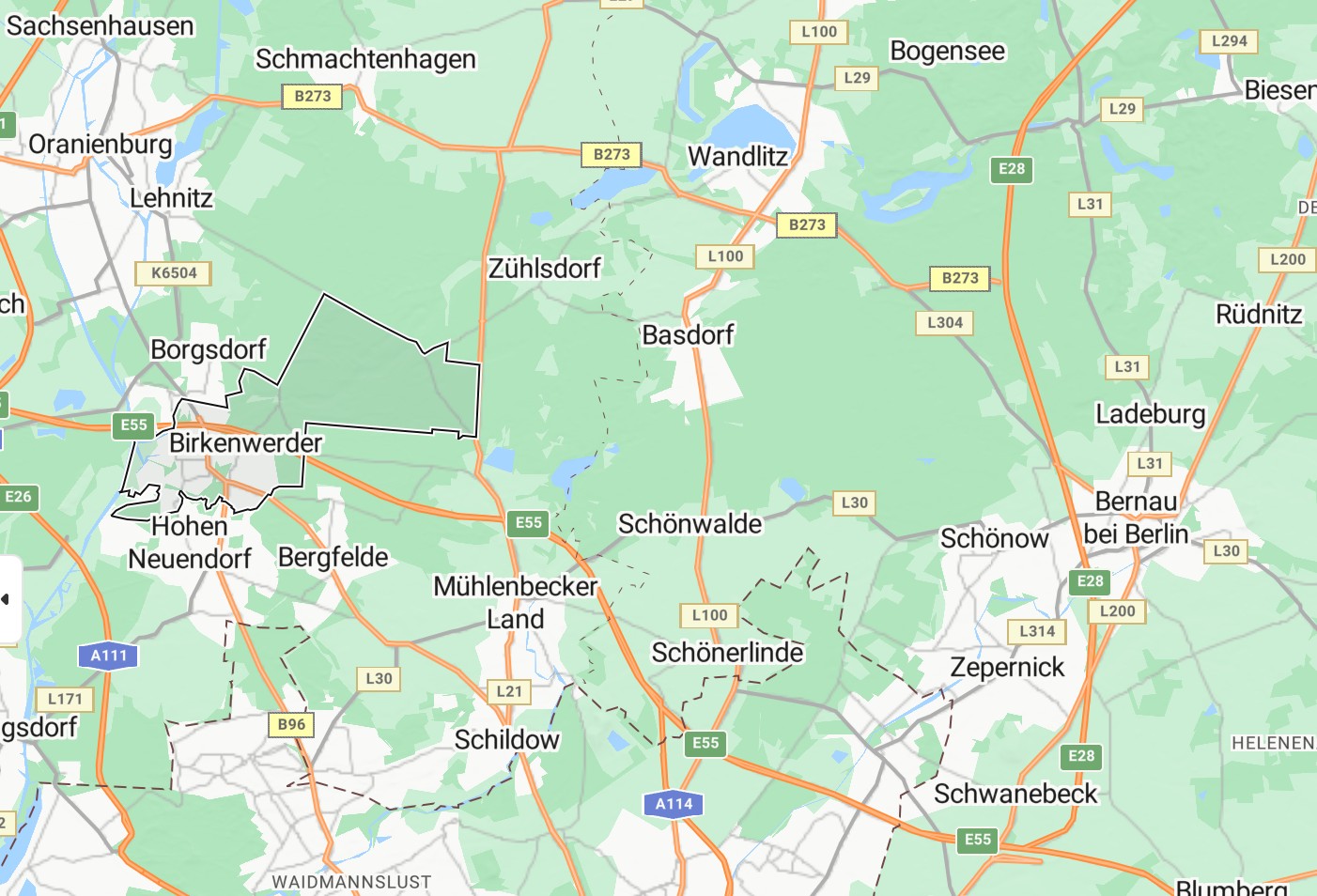
In contrast to Abwehr I and III, the radio network of the front intelligence units was organized by Abwehr II, since numerous radio connections were maintained by the signals unit of the Brandenburg Division with its radio center in Birkenwerder. Commands of Abwehr II used short-wave radio connections shortly before the start of the Polish campaign at the Jablunka Pass / Tatra, in 1940 before the invasion of Belgium and the Netherlands, as well as for securing the Danube routes and the Balkan oil industry. Before the start of the campaign against the USSR, Abwehr II had reporting posts in the border-area occupied Polish territory at Biala Podlaska, Wlodawa, Terespol, and Suwalki.
The sabotage operations of Abwehr II units in August 1942 against the oil refineries near Grozny–Maikop in the Soviet hinterland, Operation Shamil, and in May 1942 in the central sector and likewise in the Soviet rear area, Operation Graukopf, were also successfully conducted using short-wave radio communication methods.
As the war progressed, the independently created radio networks of the Brandenburg Division and Abwehr II came under heavy criticism from the Wehrmacht Signals Commander (WNV), because numerous mix-ups with enemy radio stations unnecessarily tied up the already completely insufficient resources of radio counterintelligence — especially in the East, given the large number of Soviet radio agents.
The Front Intelligence Control Center-III-East remained in Warsaw, although in another suburb (Wesola), and withdrew in autumn 1944 to Woeschen, east of Poznan.
In contrast to Abwehr I and III, the radio network of the front intelligence units was organized by Abwehr II, since numerous radio connections were maintained by the signals unit of the Brandenburg Division with its radio center in Birkenwerder. Commands of Abwehr II used short-wave radio connections shortly before the start of the Polish campaign at the Jablunka Pass / Tatra, in 1940 before the invasion of Belgium and the Netherlands, as well as for securing the Danube routes and the Balkan oil industry. Before the start of the campaign against the USSR, Abwehr II had reporting posts in the border-area occupied Polish territory at Biala Podlaska, Wlodawa, Terespol, and Suwalki.
The sabotage operations of Abwehr II units in August 1942 against the oil refineries near Grozny–Maikop in the Soviet hinterland, Operation Shamil, and in May 1942 in the central sector and likewise in the Soviet rear area, Operation Graukopf, were also successfully conducted using short-wave radio communication methods.
As the war progressed, the independently created radio networks of the Brandenburg Division and Abwehr II came under heavy criticism from the Wehrmacht Signals Commander (WNV), because numerous mix-ups with enemy radio stations unnecessarily tied up the already completely insufficient resources of radio counterintelligence — especially in the East, given the large number of Soviet radio agents.


weggum.com
Wriezen
(Deel 3.)